Home / Industries / Real Estate

Real estate marketing strategies

A practical playbook for developers, agents and property service providers who need trust, qualified site visits and steady enquiries.

Real estate marketing overview

Property is a high-value, slow decision. Buyers compare projects for weeks or months, involve family members and distrust vague promises. Marketing therefore works best when it reduces uncertainty with clear information, honest visuals and quick, helpful replies.

Marketing challenges include long sales cycles, price-sensitive buyers, seasonal demand and lead quality. Many enquiries come from curiosity rather than purchase intent, so qualification matters as much as volume.

The complete real estate marketing playbook for Indian builders and brokers

Property is the largest purchase most Indian families ever make, and buyers rarely decide in one visit. A typical homebuyer researches for three to nine months, shortlists five to eight projects on portals, visits two or three sites with family members and only then books. Real estate marketing therefore has two jobs: get on the shortlist early, and stay credible and responsive until the booking cheque is signed.

Young homebuyer couple researching apartments online on a tablet

Who this playbook is for

Developers launching residential or commercial projects, independent brokers and channel partners, plot and villa sellers in Tier 2 and Tier 3 cities, and rental or resale agents. Each sells differently: a developer sells a project and a brand, a broker sells local knowledge and choice, and a plot seller sells future value and clear titles.

Step 1: Build a credible project presence

  • RERA details everywhere: show the RERA registration number on every project page, ad and brochure. Buyers check it, and in most states it is mandatory in advertising.
  • A dedicated page for each project: location map, distance to schools, hospitals, metro and offices, floor plans with carpet area, price range or starting price, possession timeline, amenities, approvals and a downloadable brochure.
  • Real construction updates: monthly photos or drone videos of actual progress. Nothing builds trust faster for under-construction projects.
  • Google Business Profile for the site office: so people searching for the project name or new flats in your locality find directions, timings and reviews.

Step 2: Win on portals and local search

Portals such as 99acres, MagicBricks, Housing.com and NoBroker still drive a large share of enquiries. Use premium listings only for your best inventory, upload high-quality photos and refresh listings weekly so they stay near the top. In parallel, build your own SEO pages for locality searches like 2 BHK flats in a specific area or plots near a new highway. These pages bring buyers who have not yet chosen a project and cost nothing per lead once they rank.

Step 3: Paid campaigns and lead quality

Meta lead forms are cheap but often bring low-intent leads. Add one or two qualifying questions such as budget range and planned purchase time, and use Google Search ads for high-intent queries like the project name, ready-to-move flats or a specific locality. Retarget website visitors with walkthrough videos and site visit offers. Always judge campaigns by cost per site visit and cost per booking, not cost per lead.

Step 4: Speed to lead and site visits

The first builder to call back usually gets the site visit. Aim to call every new enquiry within five minutes during working hours, send a WhatsApp message with the brochure, location pin and video immediately, and offer two specific site visit slots. Use a simple CRM, even a shared sheet, to track every lead from enquiry to visit to booking so nothing goes cold.

Step 5: NRI and investor buyers

NRI buyers need video calls, virtual tours, clear documentation and help with home loans and power of attorney. Create a separate page and campaign for NRIs, schedule calls across time zones and share legal and payment processes in writing.
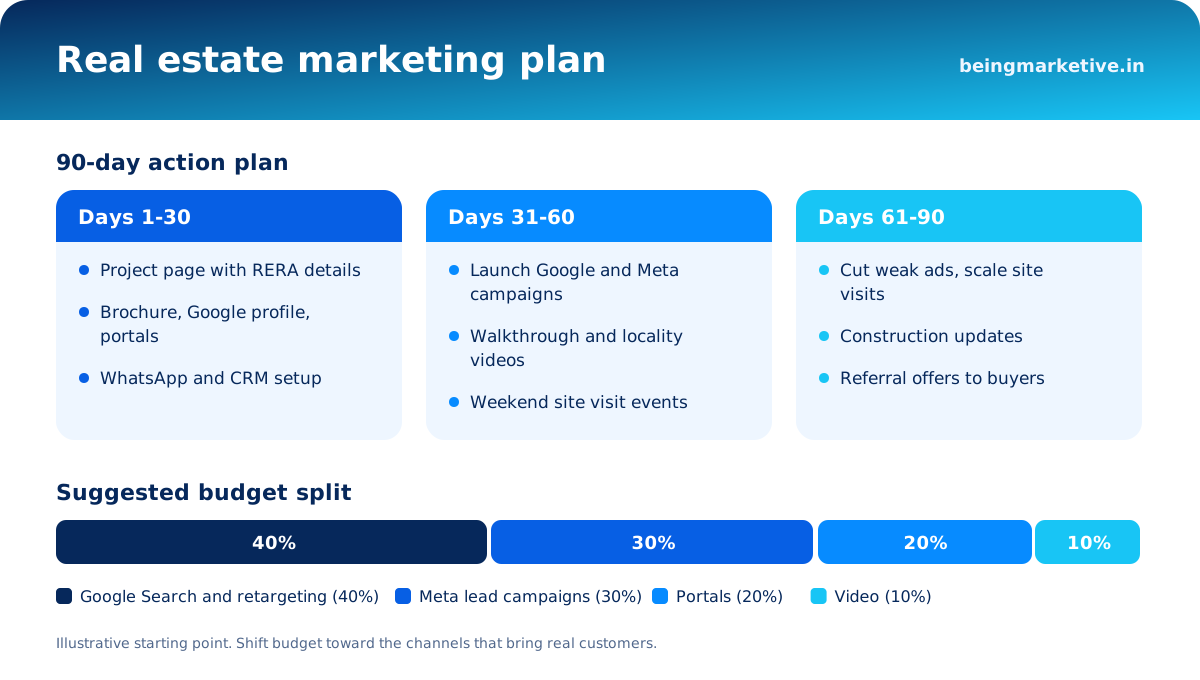
Real estate marketing 90-day launch plan and suggested budget split for builders and brokers

A realistic 90-day launch plan

  • Days 1 to 30: project page, RERA details, brochure, Google profile, portal listings, WhatsApp and CRM set up, and a pre-launch interest list.
  • Days 31 to 60: launch Google and Meta campaigns, publish walkthrough and locality videos, start channel partner briefings and weekend site visit events.
  • Days 61 to 90: cut the worst-performing ads, double down on sources that produce site visits, publish customer and construction updates, and push referral offers to existing buyers within the rules.

Budget guidance

Developers commonly plan marketing at 1 to 3 percent of project sales value. Within the digital share, a balanced start is around 40 percent on Google Search and retargeting, 30 percent on Meta lead campaigns, 20 percent on portals and 10 percent on video and content. Brokers with smaller budgets should prioritise portals, Google Business Profile and WhatsApp follow-up.

Related playbooks and services

See our lead generation guide for qualifying enquiries, our paid advertising guide for Google and Meta campaigns and our conversion optimization guide to turn more visitors into site visits.


Target audience and customer journey

Different buyers need different messages. Map them before choosing channels.

First-time buyers

Need education on loans, documents, locations and budgets before they trust a developer.

Investors

Compare yield, appreciation, builder reputation and legal clarity.

Upgrading families

Care about schools, commute, safety and neighbourhood life.

Industry-specific SEO opportunities

Search is where buyers research areas, builders and processes.

Neighbourhood guides

Pages on schools, transport, amenities and price ranges help early research.

Buying process explainers

Articles on registration steps, home loan basics and documents attract informational searches.

Project pages

One detailed page per project with floor plans, location and honest status updates.

Content and social media strategy

Educate before you promote. Short videos walking through a plan layout, a neighbourhood tour or a document checklist build credibility. Share construction progress only when it is genuine and dated.

Use Instagram and YouTube for visual tours, and keep captions factual. Link tours to a project page so interested viewers can request a site visit.

Paid advertising opportunities

Paid ads help launch projects and reach buyers outside your network.

Search ads

Target high-intent searches around project names, locations and property types.

Meta lead ads

Promote launches and virtual tours, with short forms and clear follow-up.

Remarketing

Re-engage people who viewed a floor plan but did not enquire.

Video ads

Show a tour and invite a site visit booking.

Lead generation and conversion strategy

Offer something concrete: a floor plan pack, a price breakdown call or a scheduled site visit. Reply to enquiries fast and ask two qualifying questions, such as budget range and purchase timeline.

Use WhatsApp for convenience, but keep records of consent. Show the project’s registration number where rules require it, and review advertising requirements with a qualified adviser.

Lead generation and conversion strategy

Suggested marketing funnel

A simple five-step funnel for a residential project.

01

Awareness

Video tours and locality content reach buyers early.

02

Interest

Detailed project pages and floor plan downloads answer questions.

03

Enquiry

A short form or WhatsApp message starts a conversation.

04

Site visit

A confirmed visit slot with clear directions and what to bring.

05

Decision support

Loan guidance, documentation help and honest comparisons.

Practical campaign examples (illustrative)

These are hypothetical teaching examples. They are not real client campaigns and do not show real results.

Illustrative: launch weekend

A developer runs a walkthrough video, a lead form and a site visit reminder sequence.

Illustrative: locality hub

An agent publishes guides to three areas and links each to relevant listings.

Illustrative: referral drive

A builder invites existing owners to share an honest experience, with consent.

KPIs and measurement guidance

Measure quality and speed, not only the number of enquiries.

Cost per qualified lead

Spend divided by leads that match budget and timeline.

Visit show-up rate

Share of booked visits that actually happen.

First response time

Minutes between enquiry and first useful reply.

Common marketing mistakes

Do this instead

Avoid these mistakes

Check advertising and registration rules

Real estate advertising is subject to rules, including displaying regulatory registration details in many cases. Confirm current requirements for your state and project before publishing.

Real Estate marketing FAQs

For registered projects, most state RERA rules require the registration number and the authority website to be shown in advertisements and brochures. Check your state RERA rules and add the number to every ad, landing page and print material.

Google Search usually brings fewer but higher-intent leads because people are actively searching. Facebook and Instagram bring more leads at a lower cost but need stronger qualification. Most projects use both and compare cost per site visit.

Within five minutes during working hours if possible. Response speed has a big effect on whether a lead books a site visit, so use instant WhatsApp replies and assign every lead to a named salesperson.

Yes, portals remain a major source of buyers in India, especially for ready-to-move and resale inventory. Track portal leads separately and compare their booking rate with your own website and ads before renewing packages.

It depends on your buyer and price band. Search captures active research, while video on Instagram and YouTube builds trust. Test one of each.

Use clearer messaging about price range and location, add a short qualification step and track lead quality by source.

Yes, if the buyer has agreed to it. Keep messages useful and give an easy way to stop.

Very. Genuine owner feedback and clear project history reduce perceived risk, but only publish what you can verify.

Related articles, services and resources

SEO strategy

Search fundamentals for this sector.

Paid advertising

Budgeting and campaign structure.

Lead generation guide

Capture and qualify enquiries.

Explore more marketing playbooks

See how other industries approach the same strategies, then pick one improvement to apply this week.