Most clinics in India do not lose patients because their doctors are less skilled. They lose them because a nearby competitor shows up first on Google Maps, has 300 more reviews, answers WhatsApp messages within ten minutes and explains its procedures in plain Hindi or the local language. This playbook turns those advantages into a step-by-step system you can run with a small team.
Who this playbook is for
It is written for single-doctor clinics, multi-speciality polyclinics, dental and eye clinics, physiotherapy centres, diagnostic labs and small hospitals. The principles are the same; what changes is the search intent. A diagnostic lab competes on convenience and price transparency, a fertility clinic competes on trust and privacy, and a dental clinic competes on pain-free reassurance and before-and-after education. If you run a dental practice, read our detailed dental clinic marketing playbook for India alongside this page. Physiotherapy centres can follow our physiotherapy clinic marketing guide, and eye care providers our eye hospital and optical store playbook.
Step 1: Fix the foundations before spending on ads
- Google Business Profile: choose the most specific primary category (for example Orthopaedic surgeon, not Doctor), add every service with a one-line description, upload 20 or more real photos of the reception, equipment and team, and keep holiday hours updated.
- One page per service: a page for knee replacement, one for physiotherapy after surgery, one for sports injuries. Each page should explain who it is for, what happens step by step, recovery time, and when to see a doctor urgently.
- Doctor profile pages: qualifications, registration number, years of practice, languages spoken and consultation timings. Patients and Google both look for real, verifiable expertise.
- Fast mobile booking: click-to-call, a WhatsApp button and a three-field appointment form. Most patients in India search on mobile, often on slower connections, so keep pages light.
Step 2: Build trust with educational content
Healthcare searches are often questions: what does an MRI cost, is laser treatment painful, how long after a C-section can I walk. Answer one real patient question per week in a short article and a 60-second video. Have a qualified doctor review every piece, add their name as reviewer and cite credible sources. Over six months this builds a library that ranks for hundreds of long-tail searches and gives your front desk something useful to share on WhatsApp.
Step 3: Reviews and reputation
Reviews are the single biggest driver of clinic choice on Google Maps. Ask every satisfied patient at checkout with a printed QR code and a follow-up WhatsApp message containing your review link. Reply to every review within 48 hours, including negative ones, without revealing any medical details. Never offer discounts or gifts in exchange for reviews.
Step 4: Paid campaigns that respect the rules
Google and Meta restrict healthcare advertising, and professional conduct rules for doctors in India limit self-promotion. Keep ads factual and educational: services offered, location, timings and how to book. Avoid words like best, guaranteed or 100 percent cure, and never use before-and-after images in ads. Start with Google Search ads on high-intent local terms such as physiotherapist near me or thyroid test price in your city, and a small radius around the clinic.
A realistic 90-day plan
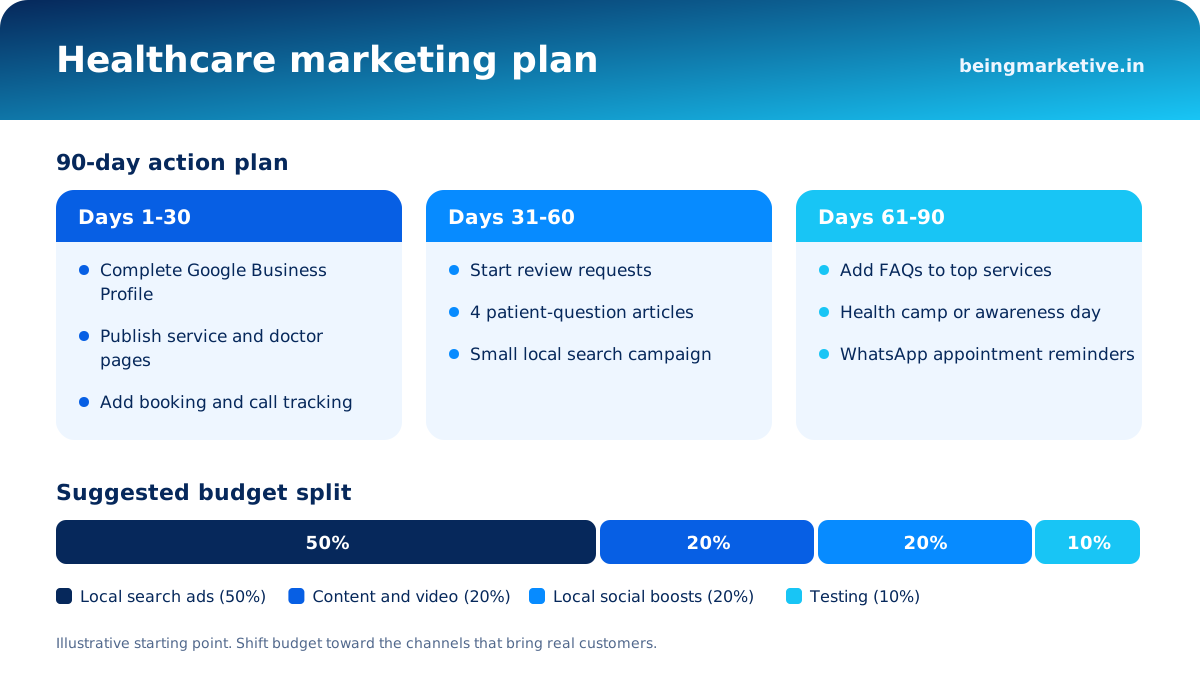
- Days 1 to 30: complete the Google Business Profile, publish service and doctor pages, add booking buttons and set up call and form tracking.
- Days 31 to 60: start the review request process, publish four patient-question articles and eight short videos, and launch a small local search campaign.
- Days 61 to 90: review which services get the most enquiries, add FAQs to those pages, test a health camp or awareness-day campaign, and build a simple WhatsApp follow-up for appointment reminders.
How to split a small monthly budget
For a clinic spending around 20,000 to 50,000 rupees a month, a sensible starting split is roughly 50 percent on local search ads, 20 percent on content and video production, 20 percent on boosting educational social posts to a local radius, and 10 percent kept aside for testing. Shift money towards whatever produces booked appointments, not just clicks or likes.
Related playbooks and services
Pair this page with our SEO strategy guide for local rankings, our paid advertising guide for compliant campaigns, and our lead generation guide to turn enquiries into booked visits. Running a fitness or wellness centre instead? See the fitness and wellness playbook.