Most people don’t look for a physiotherapist until something hurts. It might be a stiff back after months of laptop work, a knee that never recovered from weekend cricket, or a parent who needs rehab after surgery. In that moment they ask two questions: who can fix this, and how soon can I get in?
The clinic that answers both questions on Google, on WhatsApp and through the doctors and coaches people already trust gets the patient. The clinic that waits for referrals to arrive on their own spends much of the day with empty treatment tables.
This playbook shows you how to market a physiotherapy clinic in India in 2026. It covers who your patients are, how they choose, which channels bring them in, the rules to follow, and a 30-day plan you can start this week.
This article is marketing guidance, not legal advice. Rules for allied healthcare professionals in India are still being finalised, so check the current position with the NCAHP or your state council before you act.
Why physiotherapy clinics need a marketing playbook in 2026
- Patients search by pain, not by profession. People type “back pain treatment near me” or “frozen shoulder exercises”, not “physiotherapist”. If your listing and website only say “physiotherapy clinic”, you miss most of these searches.
- Treatment is a course, not a visit. Results usually need several sessions. Many patients stop once the pain eases, which hurts both their recovery and your revenue. Marketing has to keep patients through the full plan of care, not just bring them in once.
- Trust comes before the first visit. Patients worry whether therapy will hurt, whether it will work, and how many sessions they will end up paying for.
- Competition is local and growing. Home-visit physiotherapy apps, gym-based rehab and hospital departments all compete for the same patients in your area.
- The rules are changing. Physiotherapists now come under the National Commission for Allied and Healthcare Professions (NCAHP), and its professional conduct code is still in draft.
The rules to know before you promote your clinic
Physiotherapy is regulated under the National Commission for Allied and Healthcare Professions Act, 2021. In September 2026 the government notified registration regulations for allied and healthcare professionals. In April 2026 the NCAHP released a draft professional conduct and ethics code for public feedback. The draft is not final, but it shows the direction of travel, so it is sensible to market your clinic as if it already applies.
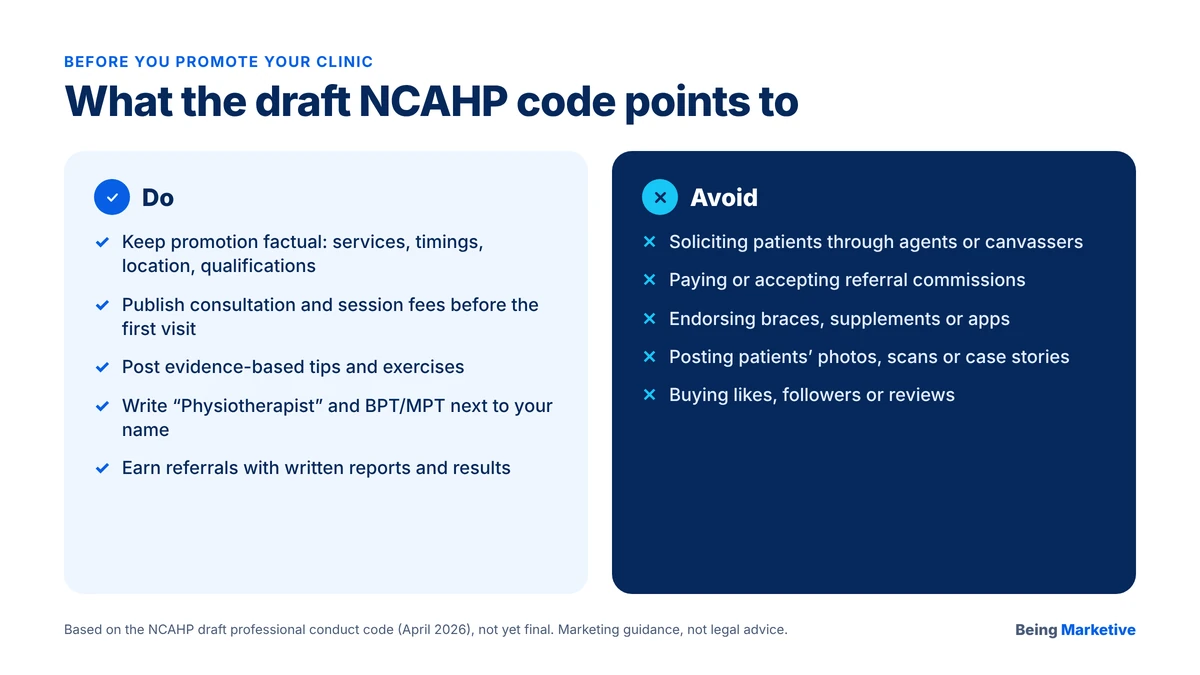
| Area | What the draft code points to | What to do |
|---|---|---|
| Advertising | Allowed in limited cases, such as starting or changing a practice | Keep promotion factual: services, timings, location, qualifications |
| Soliciting patients | Not allowed, directly or indirectly | Don’t use agents, cold canvassing or paid lead brokers |
| Endorsements | No endorsing companies, therapeutic products or software | Don’t promote braces, supplements or apps for a fee |
| Referral commissions | Seeking commission for referrals is prohibited | Build referral relationships on reports and results, never payments |
| Fees | Fees must be made known before the consultation | Publish your consultation fee and session or package prices |
| Social media | Posts should be evidence-based and verifiable; no patients’ treatment details, photos, scans or case reports; no buying likes or followers | Teach, don’t show patients; grow your audience organically |
The “Dr” prefix question
Whether physiotherapists may use “Dr” has been contested. In September 2025 the Directorate General of Health Services (DGHS) issued a directive saying they could not, then withdrew it a day later for further review. In January 2026 the Kerala High Court dismissed petitions that sought to stop physiotherapists using the prefix, holding that the title “doctor” does not belong exclusively to medical professionals.
Whatever you use, make your profession unmistakable. Write “Physiotherapist” and your qualification (BPT, MPT) next to your name on your signboard, Google profile and website, so no patient mistakes you for a medical doctor.
Know your customer: how people choose a physiotherapy clinic
| Patient segment | What they need | What they search or ask | Message that works |
|---|---|---|---|
| Desk workers with back and neck pain | Quick relief, slots around office hours | “back pain physiotherapy near me”, “neck pain exercises” | Early-morning and evening slots, posture advice |
| Post-surgery patients | A structured rehab plan their surgeon trusts | “physiotherapy after knee replacement” | Protocol-based rehab, progress reports to the surgeon |
| Sports and fitness people | Return to play, fewer repeat injuries | “sports injury physiotherapy”, “ACL rehab” | Sport-specific rehab, return-to-play testing |
| Older adults and their families | Mobility, balance, home visits | “home physiotherapy for elderly” | Home visits, fall prevention, updates for the family |
| Women before and after childbirth | Pre- and post-natal care, pelvic health | “postnatal physiotherapy near me” | A female physiotherapist on request, privacy, clear explanations |
| Neuro patients and caregivers | Long-term rehabilitation after stroke or with Parkinson’s | “stroke rehabilitation centre” | Long-term plans, caregiver training |
Most patients follow a similar path to your clinic:
- Pain or event. An injury, surgery, or pain that won’t go away.
- Search or ask. They search Google for their condition plus “near me”, or ask their doctor, gym trainer or a family WhatsApp group.
- Compare. They check ratings, reviews, photos, distance, timings and whether the clinic lists their condition.
- Enquire. They call or WhatsApp to ask the cost per session, how many sessions they’ll need and whether a home visit is possible.
- Assessment. The first session decides everything: a clear explanation, a written plan and a sense of progress.
- Plan of care. Patients who understand the plan finish it. Those who don’t often drop off after two or three sessions.
- Return and refer. A patient who recovers well comes back for the next problem, sends family, and tells their doctor or coach.
Most clinics focus their marketing on step 2. The quickest wins are usually at steps 3, 4 and 6.
The marketing channels that work best for physiotherapy clinics
- Google Business Profile — where “near me” searches land.
- Professional referrals — orthopaedic surgeons, GPs, gyms, sports academies and corporate wellness teams.
- A website with one page per condition — answers questions before patients call.
- Short exercise videos on Instagram and YouTube — build trust before the first visit.
- WhatsApp — for enquiries, exercise reminders and follow-ups.
- Google reviews — the deciding factor when patients compare clinics.
- Google Search ads — for high-intent condition searches you don’t yet rank for.
The physiotherapy clinic marketing playbook: 7 steps
Step 1: Fix the foundations
- Use the same clinic name, address and phone number everywhere: signboard, Google, website, Practo, Justdial and WhatsApp Business.
- Show each physiotherapist’s name, qualification and registration details on your website and in the clinic.
- Publish your consultation fee and session or package prices. The draft NCAHP code expects fees to be shared before consultation, and clear prices remove the biggest reason people hesitate.
- Set your hours around your patients: early mornings and evenings for office workers, daytime slots for older adults.
Step 2: List every condition you treat on your Google Business Profile
Patients search for their problem, so your Google Business Profile should name it.
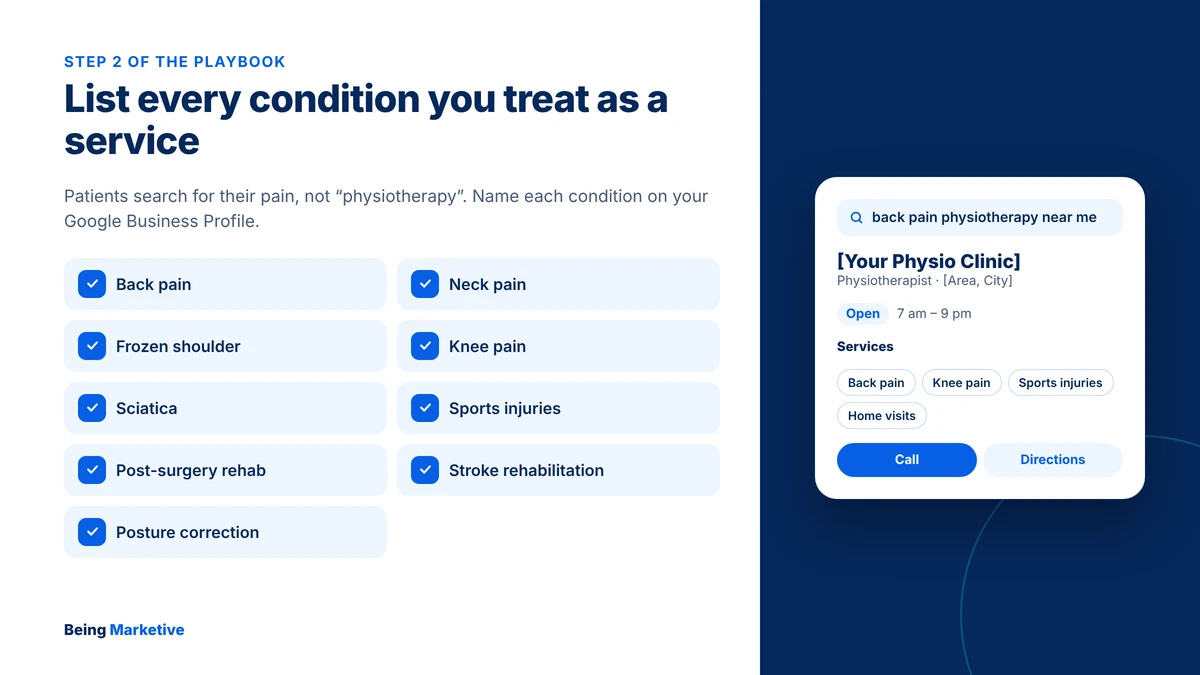
- Choose “Physiotherapist” or “Physical therapy clinic” as your primary category.
- Add each condition as a separate service: back pain, neck pain, frozen shoulder, knee pain, sciatica, sports injuries, post-surgery rehab, stroke rehabilitation and posture correction. Give each a one-line factual description.
- If you offer home visits, add them as a service and name the areas you cover.
- Upload real photos of your treatment area, equipment and team. Avoid stock images.
- Keep holiday hours updated and answer questions people post on your profile.
- Use Google posts for factual news, such as a new service, extended hours or a new physiotherapist joining.
Step 3: Build a page for every condition on your website
Each condition page should answer:
- What the condition is and what commonly causes it.
- How physiotherapy helps, and which techniques you use.
- What happens in the first session.
- The usual number of sessions, and what affects it.
- Your fees.
- Who will treat them, with qualifications.
Add a booking button, click-to-call and a WhatsApp link to every page. Avoid promises like “guaranteed cure” or “pain-free in three sessions”. Explain what usually happens and what affects recovery instead.
Step 4: Post 30-second at-home exercise reels
Short exercise videos are the best trust-builder a physiotherapy clinic has. A viewer who has already done your neck stretch at their desk knows how you explain things before they walk in.
- One exercise per video: what it’s for, how to do it, and one common mistake.
- Film your physiotherapists, not patients. The draft code bars posting patients’ photos or case details.
- Add a safety line: stop if the pain gets worse, and get assessed if it doesn’t settle.
- Add captions, because many people watch with the sound off.
- Repost your best videos to YouTube Shorts and your Google Business Profile.
- Grow followers organically. The draft code discourages buying likes or followers.
Step 5: Build a referral loop with doctors, gyms and sports academies
Referrals still matter. Your aim is to make referring to you the easy, safe choice.
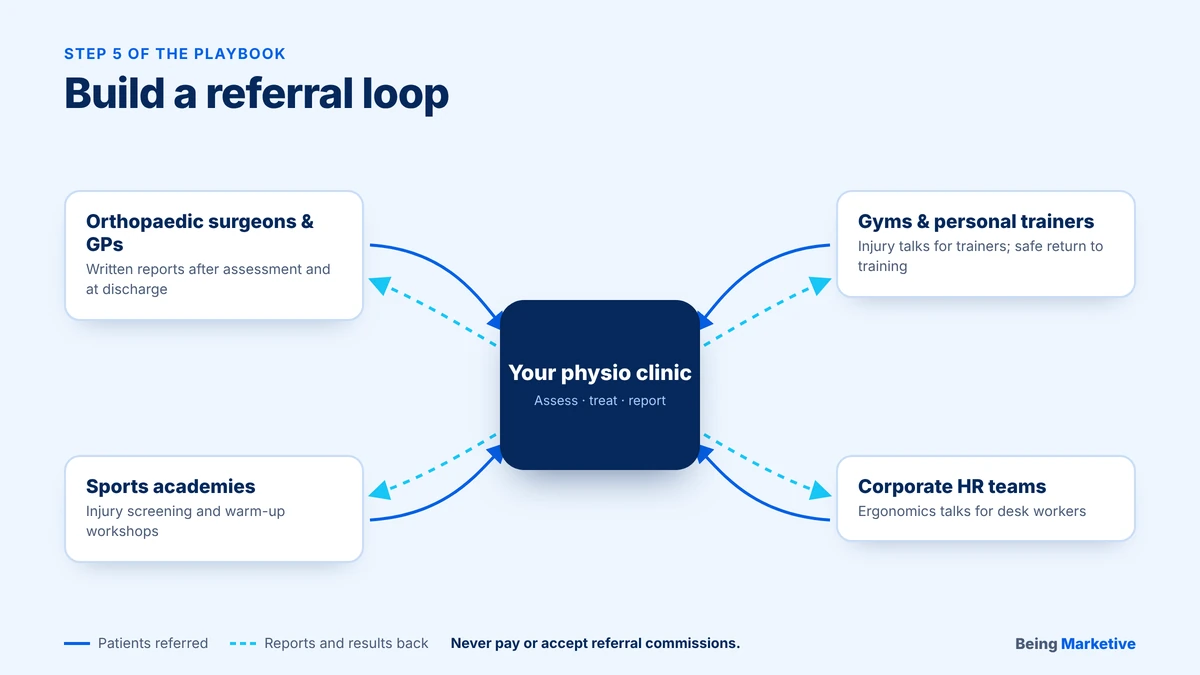
- Orthopaedic surgeons and GPs. Send a short written report after the assessment and at discharge. Follow the surgeon’s post-operative protocol and flag concerns early. Surgeons keep referring to physiotherapists whose patients recover well and who keep them informed.
- Gyms and personal trainers. Offer a short session for trainers on common injuries and when to refer. Send clients back to training with clear guidance on what’s safe.
- Sports academies and school teams. Offer injury screening or warm-up workshops as a professional service.
- Corporate offices. Ergonomics talks for HR wellness programmes reach desk workers with back and neck pain.
Never pay or accept a commission for a referral. The draft NCAHP code prohibits it, and doctors’ own ethics rules bar them from taking it.
Step 6: Turn WhatsApp enquiries into booked assessments
- Set up WhatsApp Business with quick replies for fees, timings, location and home-visit areas.
- Offer something useful in return for a WhatsApp number, such as a free home exercise guide PDF for back or neck pain. It gives the enquirer value now and lets you follow up.
- Ask for clear consent before sending follow-ups, and store patient data securely. India’s Digital Personal Data Protection Rules, 2025 are being phased in.
- Reply within an hour during clinic hours, and log where each enquiry came from.
Step 7: Keep patients through the plan of care, then ask for a review
- Give every patient a written plan after assessment: goals, number of sessions and home exercises.
- Send session reminders and exercise videos on WhatsApp between visits.
- At discharge, ask every patient for a Google review using a QR code or link. Never offer discounts or free sessions in exchange, and don’t ask only happy patients. Both break Google’s review policy.
- When you reply to reviews, don’t mention the person’s condition or treatment.
- Check in a few weeks after discharge. Recovered patients often return for the next problem and bring family.
Myth busted: “Patients only come through doctor referrals”
Many physiotherapists believe their clinic depends entirely on doctors. Referrals are valuable, but they are not the only way in.
Many patients now start with a search for their symptom: “back pain treatment near me”, “knee pain exercises”, “physiotherapy after surgery”. Others ask their gym trainer, or a friend who recovered from the same injury. A clinic that shows up for those searches, explains the condition clearly and makes booking easy can win a large share of its patients without waiting for referrals.
The two sources strengthen each other. A strong Google presence and good outcomes make doctors more confident referring to you, and referred patients leave the reviews that strengthen your Google listing.
One caution: whether physiotherapists should see patients without a referral has been debated, and the withdrawn 2025 DGHS directive said they should treat only referred patients. Assess every patient carefully, and refer them to a doctor when their symptoms need medical evaluation first.
SEO for physiotherapy clinics
Physiotherapy SEO is local SEO built around conditions. Target the map results and the first page for condition searches in your area.
| Page | Example target query |
|---|---|
| Home page | physiotherapist in [area] |
| Back pain page | back pain physiotherapy in [area] |
| Knee rehab page | physiotherapy after knee replacement in [city] |
| Sports injury page | sports physiotherapy in [city] |
| Home visits page | home physiotherapy in [area] |
| Neuro rehab page | stroke rehabilitation in [city] |
- Depth on every condition page. Two lines per service rarely rank.
- Answer cost questions. People search “physiotherapy cost per session”. A page that states your prices and explains what affects them answers that intent.
- Credible authorship. Show the physiotherapist’s name and qualification on each page.
- Local signals. Your area in page titles, an embedded map, and consistent listings on directories such as Practo and Justdial.
- Technical basics. A fast, mobile-first site, click-to-call, and Physiotherapy structured data from schema.org on your home page.
The same local SEO approach works for other clinics. See how it applies to diagnostic labs, to dentists in ourdental clinic marketing playbook and to eye hospitals and optical stores, or explore more healthcare marketing ideas. If you also run a gym or rehab studio, see the fitness and wellness playbook.
Social media beyond exercise reels
- Posture carousels: desk setup, phone neck, safe lifting at home.
- Myth-busting: “rest is always best for back pain”, “knee pain at 40 is just age”.
- Behind the scenes: what an assessment looks like, your equipment, your team.
- Live Q&A: a monthly Instagram live on a common problem.
- LinkedIn: ergonomics tips that reach the HR teams who book corporate talks.
Paid advertising for physiotherapy clinics
Google Search ads reach people already looking for help.
- Target condition searches plus “near me” within a realistic travel radius.
- Send each ad to the matching condition page, not your home page.
- Run call ads only during clinic hours.
- Keep copy factual: conditions treated, timings, location, qualifications. No guaranteed results.
- Check Google’s Healthcare and medicines policy before launch.
- Judge results by cost per booked assessment, not cost per click.
Meta ads on Facebook and Instagram suit local awareness for your best reels. Avoid copy that implies the viewer has a condition, such as “Is your back pain ruining your day?”. Meta’s policies reject ads that assert personal health attributes.
Conversion optimisation: from enquiry to completed recovery
- Phone number and WhatsApp button visible on mobile without scrolling.
- Prices, timings and home-visit areas stated plainly.
- Physiotherapist profiles with qualifications.
- Real clinic photos.
- A written plan of care for every patient.
Track these numbers every month: enquiries by source, assessments booked, plan-of-care completion (sessions attended against sessions planned), new reviews, and referrals by partner.
Example: how a neighbourhood clinic could apply this
This is an illustrative scenario, not a real clinic or result.
A two-therapist clinic in a Pune suburb gets most patients from one orthopaedic surgeon. Its Google profile lists only “physiotherapy”, and many patients stop after three sessions.
The clinic adds nine conditions as services on Google, builds pages for back pain, knee rehab and sports injuries, and posts two exercise reels a week. It starts sending written reports to four surgeons and two gyms. Every patient gets a written plan and WhatsApp reminders, and is asked for a review at discharge.
After three months, the clinic compares enquiries by source and plan-of-care completion against its starting point. That data shows which channels to invest in next.
30-day action plan and budget tiers
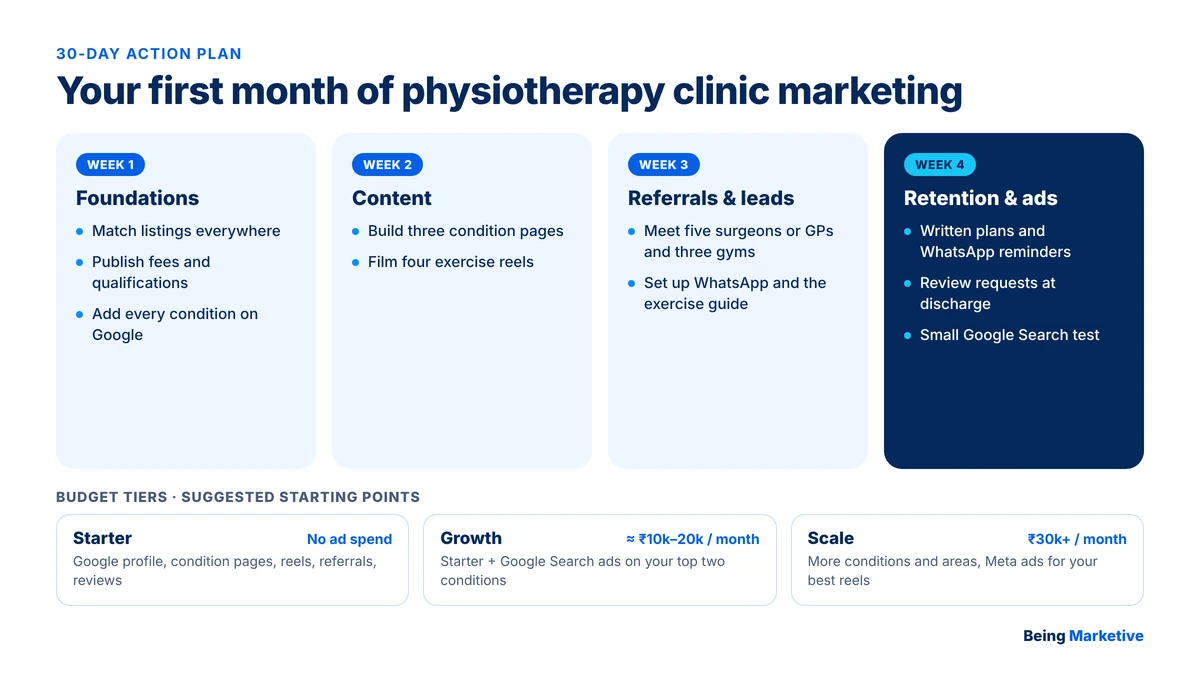
| Week | Actions | Done when |
|---|---|---|
| Week 1: Foundations | Match name, address and phone across listings; add qualifications and a fee list; set up your Google profile with every condition as a service | Profile complete and fees published |
| Week 2: Content | Build three condition pages (back pain, knee rehab, neck pain); film your first four exercise reels | Pages live and reels scheduled |
| Week 3: Referrals and leads | Meet five surgeons or GPs and three gyms with a one-page referral note; set up WhatsApp Business and your home exercise guide | First referral partners agreed |
| Week 4: Retention and ads | Start written plans of care, WhatsApp reminders and review requests at discharge; test a small Google Search campaign | Reviews coming in; ads running with call tracking |
Choose a budget tier that fits your clinic. These are suggested starting points, not benchmarks; adjust them to your city and how many patients you can take.
| Tier | Monthly ad spend | Focus |
|---|---|---|
| Starter | None | Google profile, condition pages, reels, referrals and reviews |
| Growth | About ₹10,000–₹20,000 | Everything in Starter, plus Google Search ads on your two most-booked conditions |
| Scale | ₹30,000 and up | More conditions and areas in Search, Meta ads to promote your best reels, and a part-time content helper |
Common physiotherapy marketing mistakes
- Listing only “physiotherapy” instead of the conditions patients search for.
- Hiding prices until the patient walks in.
- Promising cures or a fixed number of pain-free sessions.
- Posting patient photos or case stories.
- Paying or accepting commissions for referrals.
- Letting patients drift away mid-treatment without reminders.
- Buying followers, likes or reviews.
- Measuring followers instead of booked assessments and completed plans.
Conclusion
Physiotherapy clinic marketing in India comes down to being found for the pain people have, trusted before they walk in, and remembered after they recover. Name every condition you treat, teach through short videos, earn referrals with good reports and results, and keep patients through the full plan of care.
Start with the 30-day plan, measure booked assessments and completed plans, and build from there. Being Marketive publishes a new industry playbook like this regularly. Learn more about us, or get in touch if you want help adapting it for your clinic.
Frequently asked questions
How can I get more patients for my physiotherapy clinic?
List every condition you treat as a separate service on your Google Business Profile, build a website page for each condition, and publish your prices. Then build referral relationships with surgeons, GPs and gyms, and ask every patient for a review at discharge.
Can physiotherapists advertise in India?
The NCAHP’s draft professional conduct code, released in April 2026, allows advertising only in limited cases and bars soliciting patients. It is not final yet, so keep all promotion factual and check the current rules before running campaigns.
Can physiotherapists use “Dr” before their name?
The issue has been contested. A September 2025 DGHS directive against it was withdrawn a day later, and in January 2026 the Kerala High Court dismissed petitions to stop physiotherapists using the prefix. Always state “Physiotherapist” and your qualification next to your name.
Is it okay to pay doctors for referrals?
No. The draft NCAHP code prohibits seeking commissions for referrals, and doctors’ ethics rules bar them from accepting commissions. Earn referrals with clear reports and good patient outcomes.
Should a physiotherapy clinic run Google Ads?
It can work well for high-intent condition searches. Start small, send each ad to the matching condition page, track calls and bookings, and judge results by cost per booked assessment.
What should a physiotherapy clinic post on Instagram?
Short exercise reels, posture tips, myth-busting posts and behind-the-scenes clips of your clinic. Feature your physiotherapists rather than patients, and keep every claim evidence-based.
Sources
- Careers360: What NCAHP’s first ethics code for allied healthcare professionals says (April 2026)
- ThePrint: Allied and healthcare profession regulations notified (October 2026)
- ThePrint: DGHS withdraws directive on the “Dr” prefix (September 2025)
- LiveLaw: Kerala High Court permits physiotherapists to use the “Dr” prefix (January 2026)
- Google Maps: prohibited and restricted content
- Google Ads: Healthcare and medicines policy update