Most people choose a dentist in one of two moments. The first is a toothache that won’t wait: they search “dentist near me”, scan the map, and call whoever looks trustworthy and open right now. The second is a decision they’ve put off for months, like braces, an implant or a crown. Here they compare clinics, read reviews, ask friends and worry about the bill.
A clinic that wins both moments has a full appointment book. A clinic that relies on its signboard and word of mouth waits for patients to find it.
There is a catch that most marketing advice ignores. Dentists in India are bound by the Revised Dentists (Code of Ethics) Regulations, 2014, issued by the Dental Council of India (DCI). These rules allow advertising with decorum, but they ban several tactics that agencies routinely sell to clinics. This playbook shows you how to grow patient numbers using channels that work, while staying inside those rules.
This article is marketing guidance, not legal advice. Your State Dental Council has the final word on what is permitted.
Why marketing a dental clinic is harder than it looks
Dental clinics face a mix of problems that most local businesses don’t.
- Patients can’t judge clinical skill. They can’t tell a good root canal from a poor one, so they judge on trust signals: reviews, cleanliness, how the front desk answers, and how clearly fees are explained.
- Fear delays decisions. Many people avoid the dentist until pain forces them in. Your marketing has to reduce anxiety, not just announce services.
- Fear of the bill is real. Patients worry about surprise costs, especially for root canals, implants and aligners. Vague pricing loses them to the clinic that explains it.
- Competition is hyper-local. Most patients won’t travel far for routine care, so you compete with the few clinics nearest to them, not with every clinic in the city.
- What you can say is restricted. You can’t call yourself the best, boast about cases, or run many of the promotional tactics other businesses use.
The good news is that the last point pushes you toward the channels that work best anyway: being easy to find, easy to trust and easy to book.
What the DCI code allows and forbids in dental advertising
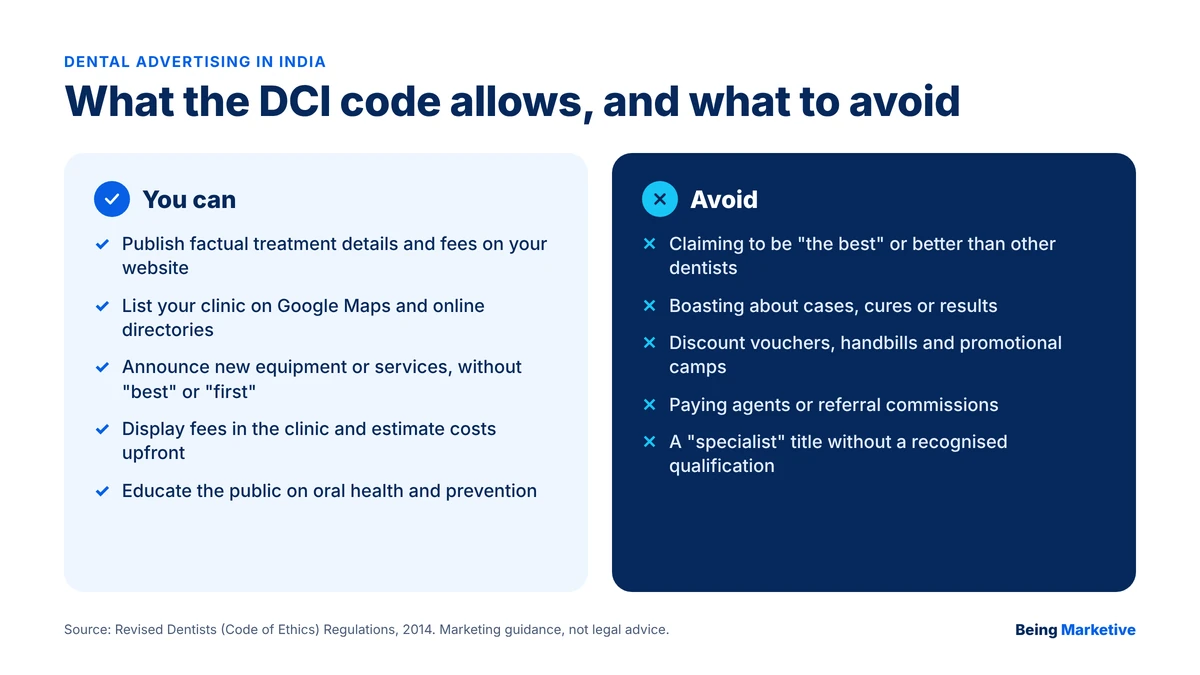
Chapter 6 of the 2014 regulations covers advertising, soliciting and signage. The code says a dentist or group of dentists may advertise if they maintain decorum. Here is what that means in practice.
| Area | What you can do | What to avoid | Clause |
|---|---|---|---|
| Website | Publish factual information about your dentists, treatments and fees | Claims that aren’t factual or could mislead | 8.2.9 |
| Online listings | List the clinic on internet directories and maps as public information | Claiming superiority or special skills over others | 8.2.8 |
| New services | Announce new equipment or services | Calling them the “best” or “first” | 8.2.7 |
| Announcements | Formally announce opening, relocating, changing practice type, long absences or resuming practice | Turning announcements into promotional campaigns | 8.2.1–8.2.6 |
| Fees | Display fees in the clinic and give estimates before treatment | “No cure, no payment” contracts | 5.7.1, 3.8 |
| Public education | Educate the public on oral health and prevention | Educational content used as disguised ads that carry your address or phone number | 7.2, 8.1.8 |
| Promotions | Run clinic-based services transparently | Camps in schools, colleges or old age homes, handbills, claim vouchers and similar promotions (fully free care by registered charities is exempt) | 8.1.2 |
| Patient sourcing | Accept referrals from other doctors | Paying agents or canvassers, or giving or taking referral commissions | 8.1.4, 8.6.1 |
| Results | Explain what a treatment involves | Boasting about cases, operations or cures, or publishing reports of them | 8.2 |
| Signboard | A sign sized to show your location and entrance, with name and qualifications | Your own photo on the signboard or letterhead; flashing signs; oversized boards | 8.3.1, 8.3.2, 8.1.5 |
| Titles | Show recognised qualifications and your registration number | Claiming to be a specialist without a council-recognised specialist qualification | 8.3.3, 3.4 |
| Naming | Call the practice a dental clinic | Calling it a “dental hospital” unless it meets the in-patient criteria | 8.10 |
| TV | — | On-screen scrollers showing dentists’ names, addresses and phone numbers | 8.1.9 |
The takeaway: your marketing must win on information, convenience and genuine patient experience, not on hype or inducements. Every strategy below is built around that.
Who your patients are
A dental clinic serves several distinct groups. Each one searches differently and needs a different message.
| Patient segment | What they need | What they typically search or ask | Message that works |
|---|---|---|---|
| Pain and emergency patients | Fast relief, today | “dentist near me open now”, “tooth pain dentist” | Same-day appointments, timings, one-tap calling |
| Parents with young children | A gentle, child-friendly dentist | “kids dentist near me”, “first dental visit age” | Calm environment, what to expect, preventive care |
| Working professionals | Convenient slots and minimal visits | “aligners cost”, “teeth cleaning near office” | Evening or weekend hours, number of visits, clear fees |
| Adults weighing major treatment | Confidence and cost clarity | “dental implant cost”, “root canal vs extraction” | Treatment explainers, fee ranges, the dentist’s qualifications |
| Older adults and their families | Comfort, dentures, implants, accessibility | “denture clinic near me”, “implants for elderly” | Accessibility, unhurried consultations, family involvement |
How patients choose a dentist: the buying journey
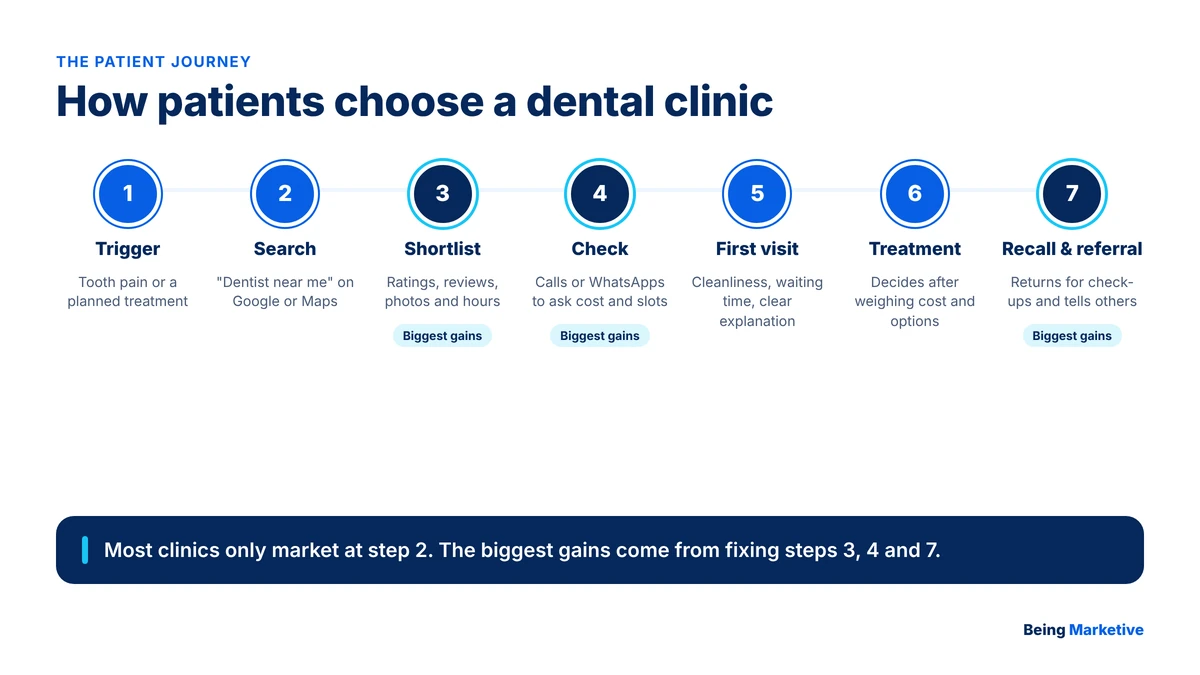
- Trigger. Pain, a broken tooth, a child’s check-up, or an ongoing worry about appearance.
- Search. Most start on Google or Google Maps with “dentist near me” or a treatment plus their area. Others ask family or a local WhatsApp group.
- Shortlist. They compare the clinics shown on the map: rating, number of reviews, photos, distance and opening hours.
- Check. They visit the website or call or WhatsApp to ask about availability and approximate cost. Slow or unclear replies end the journey here.
- First visit. Cleanliness, waiting time and how well the dentist explains the treatment plan decide whether they go ahead.
- Treatment acceptance. For high-value treatment, they may take days or weeks and seek a second opinion.
- Recall and referral. A patient who is reminded about check-ups returns. A patient who had a good experience tells others and may leave a review.
Most clinics only market at step 2. The biggest gains usually come from fixing steps 3, 4 and 7.
The marketing channels that work best for dental clinics
In order of priority for a typical neighbourhood clinic:
- Google Business Profile and Maps — where most local patient journeys start.
- A website with one page per treatment — answers the questions patients ask before they call.
- Google reviews — the main trust signal patients use to shortlist clinics.
- Phone and WhatsApp handling — where enquiries turn into bookings, or don’t.
- A recall system — the cheapest source of repeat appointments.
- Google Search ads — to capture high-intent searches you don’t yet rank for.
- Instagram and YouTube education — to build familiarity and reduce fear over time.
- Relationships with local doctors — genuine, commission-free referrals.
The dental clinic marketing playbook: 7 steps
Step 1: Fix the foundations
Before spending on promotion, make sure the basics are consistent and compliant.
- Use the exact same clinic name, address and phone number everywhere: signboard, website, Google, Practo, Justdial and WhatsApp Business.
- Display each dentist’s State Dental Council registration number in the clinic and on prescriptions and receipts, as clause 3.4.1 requires. Show it on the website too; it is a quiet but strong trust signal.
- Name the practice a “dental clinic” unless it genuinely qualifies as a dental hospital.
- Use “orthodontist”, “endodontist” or other specialist titles only for dentists who hold the recognised specialist qualification.
Step 2: Build a Google Business Profile that earns the click
Your profile is often the first and only thing a patient sees before calling.
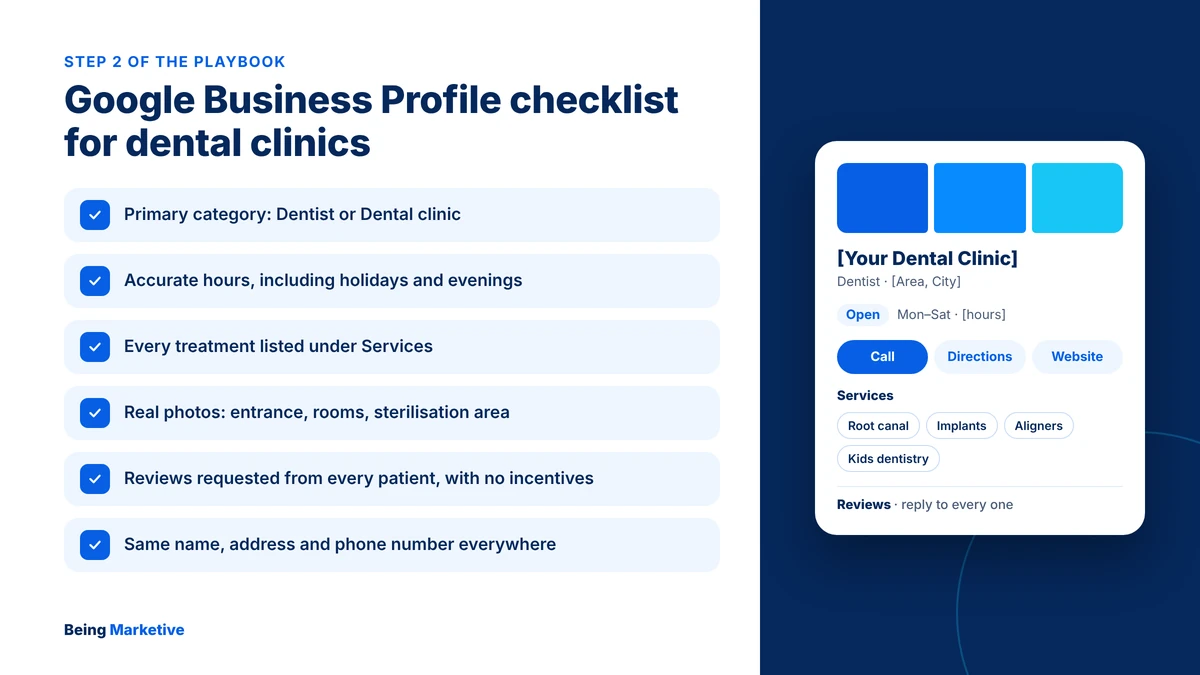
- Choose “Dentist” or “Dental clinic” as the primary category. Add specialist categories only if a qualified specialist practises there.
- Follow Google’s practitioner rules. Public-facing dentists in a multi-dentist clinic can have their own listings. A solo dentist is usually best served by one listing that combines the clinic and dentist name.
- Keep hours accurate, including holidays and evening slots. A patient in pain who finds a closed clinic won’t come back.
- List every treatment under Services, with a short factual description.
- Upload real photos: the entrance, reception, treatment rooms and sterilisation area. Avoid stock images.
- Post updates for genuine news, such as new equipment or changed hours, in plain factual language.
Step 3: Turn your website into a patient information centre
The DCI code explicitly allows websites to carry treatment details and fees, and says this helps patients make informed choices. Use that.
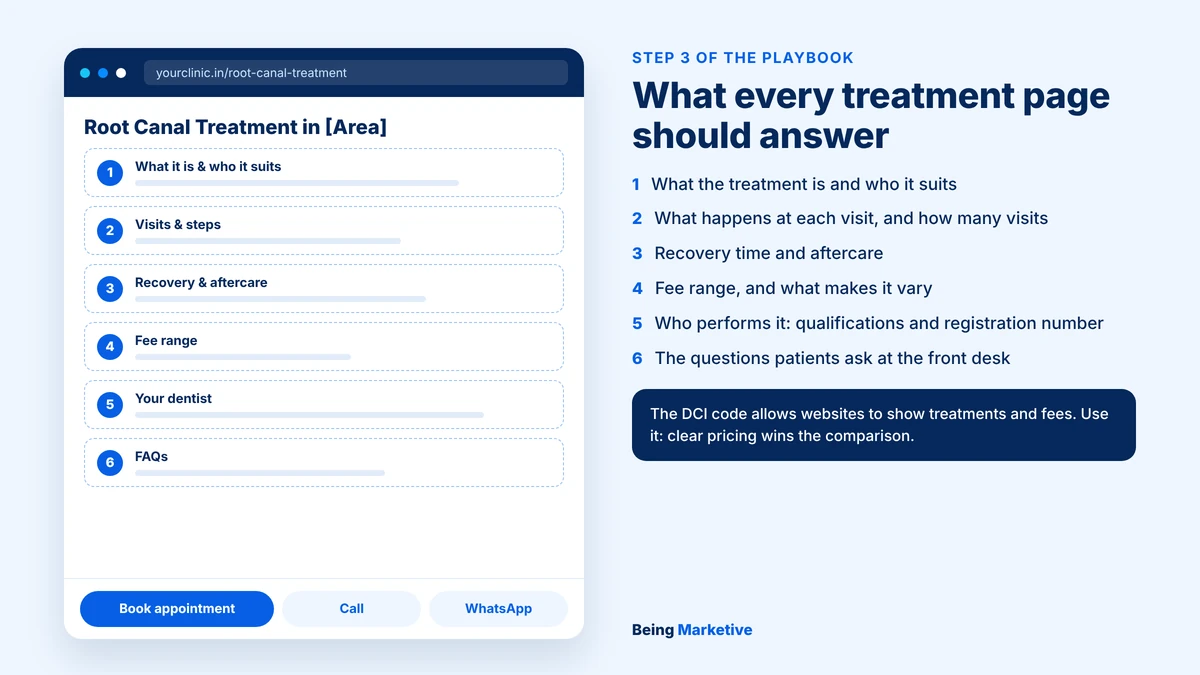
Create one page for each core treatment: root canal, implants, braces and aligners, crowns and bridges, dentures, children’s dentistry, cleaning and whitening. Each page should answer:
- What the treatment is and who it suits.
- What happens at each visit, and how many visits it usually takes.
- What recovery and aftercare look like.
- The fee range, and what makes it vary.
- Who performs it, with qualifications and registration number.
- Common questions patients ask at the front desk.
Add a clear “Book an appointment” button, click-to-call and a WhatsApp link on every page.
Step 4: Grow Google reviews the right way
Reviews are the main trust signal on the map, and Google’s rules on them are strict.
- Ask every patient, not only the happy ones. Sending only satisfied patients to Google (review gating) breaks Google’s policy.
- Never offer discounts, free cleaning or gifts in exchange for a review, even for an honest one.
- Don’t set staff review quotas or push patients to mention staff names. Google tightened its rules on both.
- Make it easy: a short link or QR code at the reception desk and in the post-visit WhatsApp message.
- Reply to every review politely. In replies, never confirm that the person is your patient or mention their treatment; patient confidentiality (clause 4.2) applies here too.
- Be careful about reposting reviews, testimonials or before-and-after photos as promotional content. The code prohibits boasting about cases, so check with your council before doing this.
Step 5: Answer enquiries like it matters
Many clinics lose patients after the patient has already chosen them, because nobody answered the phone or the WhatsApp reply came hours later.
- Set up WhatsApp Business with your timings, address and quick replies for common questions.
- Agree a target response time during clinic hours, and assign one person to own it.
- Give the front desk a simple script: acknowledge the problem, offer the earliest slot, state the consultation fee, and explain how treatment costs are estimated after examination.
- Log every enquiry with its source (Google, website, referral, ads) so you know which channel produces patients.
Step 6: Build a recall system
Your existing patients are your cheapest source of appointments.
- Send check-up and cleaning reminders at the interval your dentists recommend.
- Follow up on treatment plans that patients accepted in principle but haven’t started.
- Collect clear consent for reminder messages and store patient data securely. India’s Digital Personal Data Protection Rules, 2025 are being phased in, so review your consent wording and data handling with an adviser.
Step 7: Educate without disguised advertising
Public education is encouraged; disguised advertising is not. Publish useful content on your website, YouTube and Instagram, under your clinic’s own account. Don’t place “educational” articles or TV segments in outside media that carry your clinic’s phone number or address to attract patients (clause 8.1.8).
SEO for dental clinics
Dental SEO is local SEO. Your target is the map results and the first page for treatment searches in your area.
| Page | Example target query |
|---|---|
| Home page | dentist in [your area] |
| Root canal page | root canal treatment in [area], root canal cost |
| Implants page | dental implants in [city], dental implant cost |
| Braces and aligners page | braces for adults, clear aligners in [city] |
| Children’s dentistry page | kids dentist in [area] |
| Emergency page (only if you offer it) | emergency dentist in [area] |
Five things matter most:
- Treatment pages with real depth. Thin pages with two lines per service rarely rank.
- Cost guides. Patients search for costs constantly. A page that explains what drives the cost of a root canal or implant, with your fee range, answers that intent.
- Credible authorship. Have a registered dentist write or review clinical content, and show their name and qualifications.
- Technical basics. A fast, mobile-first site, click-to-call, embedded map, and Dentist structured data on the home page.
- Consistent listings. Accurate entries on directories such as Practo and Justdial, which clause 8.2.8 permits as public information.
Social media marketing for dentists
Social media builds familiarity and reduces fear. It rarely produces urgent bookings on its own.
- Short explainers: what happens during a root canal, how aligners work, how to brush a toddler’s teeth.
- Myth-busting: cleaning doesn’t weaken teeth, a missing tooth affects the teeth around it.
- Behind the scenes: the sterilisation process, the clinic, how a first visit works.
- Patient privacy first: never show a patient’s face, mouth or records without written consent.
- Skip transformation posts by default: before-and-after content risks breaching the code on boasting about cases, and ad platforms restrict it in health advertising.
Lead generation strategies that stay compliant
- Google Business Profile calls and direction requests — usually the largest source for a neighbourhood clinic.
- Website booking and WhatsApp — keep the form to name, phone and preferred time.
- Doctor referrals — build relationships with nearby GPs, paediatricians and ENT specialists by sending case summaries and referring back. Never pay or accept commission for referrals.
- Recall and reactivation — patients who haven’t visited in over a year.
Avoid discount vouchers, handbill drops, “free camp” outreach in schools or old age homes, and lead agents paid per patient. All of them fall under the code’s prohibited practices.
Paid advertising for dental clinics
Google Search ads suit dental clinics because they catch people already looking for a dentist.
- Target treatment and “near me” searches within a realistic travel radius.
- Run call ads during clinic hours only.
- Write factual copy: treatments, timings, location, qualifications. No “best dentist”, no guaranteed results.
- Check Google’s Healthcare and medicines policy before launch; ads targeting India can’t promote prescription drugs, and health-based audience targeting is restricted.
- Judge results by cost per booked appointment, not cost per click.
Meta ads (Facebook and Instagram) suit awareness within your area. Keep copy neutral; ad copy that implies the viewer has a dental problem breaches Meta’s policies. Start with a small test budget and scale only what produces bookings.
Conversion optimisation: turn visitors into appointments
- Phone number and WhatsApp button visible without scrolling on mobile.
- Opening hours and location on every page.
- Fee ranges and payment options stated plainly.
- Dentist names, qualifications and registration numbers on the website’s team page.
- Real clinic photos, including the sterilisation area.
- Call tracking or a source question at booking, so you know what works.
Track these numbers every month: enquiries by source, booked appointments, show rate, treatment plans accepted, and new reviews.
Example: how a neighbourhood clinic could apply this
This is an illustrative scenario, not a real clinic or result.
A two-chair clinic in a Hyderabad residential suburb gets most patients from walk-ins and word of mouth. Its Google profile has 14 reviews, no photos and outdated hours. The website is a single page.
The clinic corrects its hours, adds real photos and lists its services on Google. It builds pages for root canals, implants, aligners and children’s dentistry with fee ranges. The front desk starts asking every patient for a review via a QR code and replies to WhatsApp within the hour. Recall messages go to patients due for check-ups. A small Google Search ad campaign covers implant and aligner searches within a short radius.
After three months, the clinic compares enquiries by source and cost per booked appointment against its starting point. That data tells it where to put more money next.
Your 30-day dental clinic marketing plan
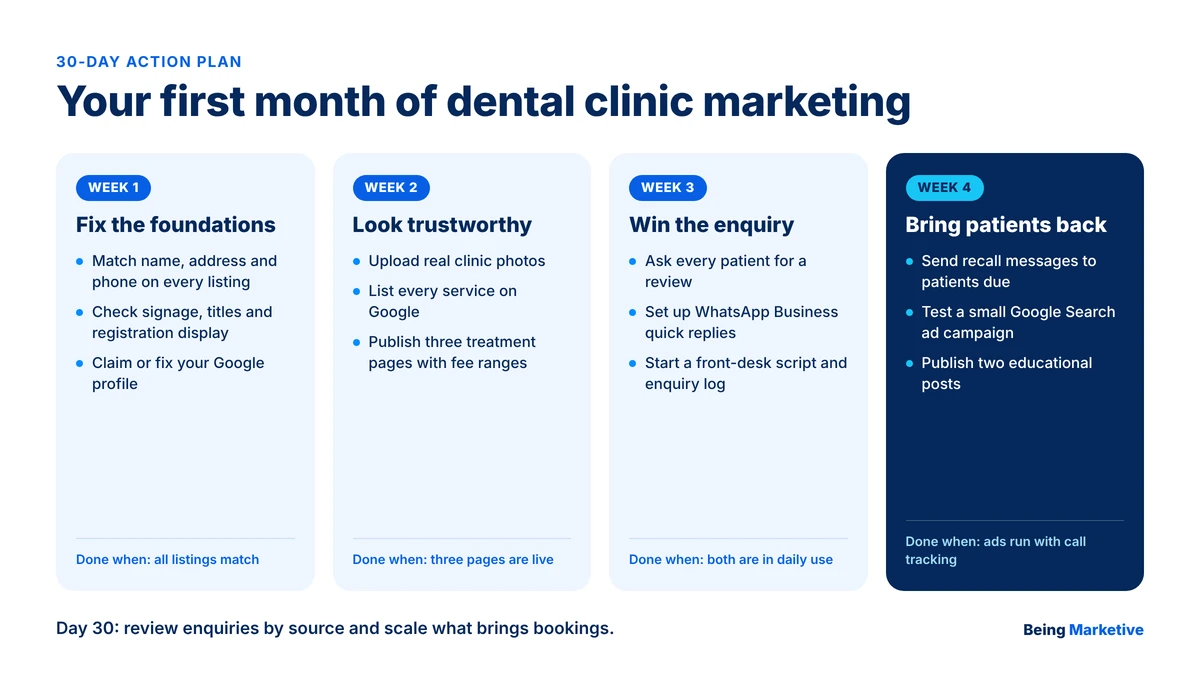
| Week | Actions | Done when |
|---|---|---|
| Week 1 | Audit name, address and phone across all listings; check signage, titles and registration display against the DCI code; claim or fix your Google Business Profile | All listings match and the profile is complete |
| Week 2 | Upload real photos; list all services; write or rewrite the three most important treatment pages with fee ranges | Profile has photos and services; three pages live |
| Week 3 | Start asking every patient for a review; set up WhatsApp Business quick replies; give the front desk an enquiry script and log | Review requests and enquiry log in daily use |
| Week 4 | Launch a recall message to patients due for check-ups; start a small Google Search ad test; publish two educational posts | First recall batch sent; ads running with call tracking |
At day 30, review enquiries by source and decide what to scale.
Common dental marketing mistakes
- Paying for discount coupons, flyers or school camps that the code prohibits.
- Calling the clinic “the best” or a dentist a “specialist” without the qualification.
- Buying reviews, offering incentives for them, or only asking happy patients.
- Leaving hours, phone numbers or photos outdated on Google.
- A one-page website with no treatment details or fees.
- Slow or unanswered phone calls and WhatsApp messages.
- Posting patient photos or before-and-after images without thinking through consent and the code.
- Measuring clicks and followers instead of booked appointments.
Ready to add paid ads? Our Google Ads for dental clinics playbook covers campaign setup, compliant ad copy, tracking and budgets.
The same approach works across healthcare. See our playbooks for diagnostic labs,physiotherapy clinics and eye hospitals and optical stores, or explore the full healthcare marketing playbook.
Conclusion
Dental clinic marketing in India isn’t about shouting louder than the clinic down the road. You can’t, and patients don’t want it. It is about being easy to find, easy to trust and easy to book.
Get your Google profile right, publish honest treatment and fee information, earn reviews the right way, answer every enquiry quickly, and remind patients when they’re due. Do that consistently, inside the DCI code, and your appointment book fills without risking your registration.
Start with this month’s 30-day plan, measure booked appointments, and build from there.
Frequently asked questions
Are dentists allowed to advertise in India?
Yes, with limits. The Revised Dentists (Code of Ethics) Regulations, 2014 let dentists advertise while maintaining decorum. They prohibit false promises, claims of superiority, boasting about cases, inducements and several promotional tactics. Check specifics with your State Dental Council.
Can a dental clinic show treatment prices on its website?
Yes. The code says websites may carry details of treatment facilities and their fees, and that there is no bar on displaying fees in the clinic. Keep the information factual and explain what makes costs vary.
How can a dental clinic get more Google reviews?
Ask every patient after their visit, using a QR code at reception or a link in a follow-up message. Don’t offer any reward for reviews, don’t ask only satisfied patients, and don’t set staff quotas. All three break Google’s review policy.
Is Google Ads worth it for a dental clinic?
It can be, because search ads reach people already looking for a dentist. Start with a small budget on treatment and “near me” searches within a realistic radius, track calls and bookings, and judge it by cost per booked appointment.
Can I post before-and-after photos of patients?
Treat this with caution. The DCI code prohibits boasting about cases or publishing reports of them, and ad platforms restrict before-and-after images in health ads. Always get written consent, and confirm with your council before using them.
Can I run free dental camps to get patients?
The code bars promotional camps in schools, colleges and old age homes, along with handbills and claim vouchers. Registered charitable bodies providing fully free treatment are exempt. Commercial clinics should avoid camps used for patient acquisition.
What is the most important marketing step for a new dental clinic?
A complete, accurate Google Business Profile with real photos, correct hours and listed services. Pair it with fast responses to calls and WhatsApp messages, since that is where most first enquiries land.
How long does dental clinic SEO take to show results?
There is no fixed timeline. Google profile improvements can affect map visibility relatively quickly, while new treatment pages usually take longer to rank. Results depend on local competition and the depth of your content.