Education marketing in India runs on a calendar. Schools fill seats between October and March, colleges chase students around board results and entrance exam counselling, and coaching institutes peak before every exam cycle. Miss the window and even a strong institution loses a full year of admissions. This playbook helps you plan backwards from your admission season and win the trust of both students and parents.

Who this playbook is for
K-12 schools, pre-schools and day-care centres, degree and professional colleges, coaching and test-prep institutes, skill and certification academies, and online course creators. In school marketing the parent is the decision maker. In college and coaching marketing the student researches first and the parent approves the fee. Your messaging must speak to both.
Step 1: Make your institution easy to evaluate
- Programme pages: one page per course, class range or batch, with eligibility, duration, fee range, schedule, faculty and outcomes such as results or placements, stated honestly.
- Admission page: the process, important dates, documents needed and a clear enquiry or application form. Many institutions hide this information, which pushes parents to competitors.
- Faculty and campus proof: real teacher profiles, classroom and lab photos, transport routes and safety measures. For schools, safety and teacher quality are often the top parent concerns.
- Google Business Profile: correct category, photos, admission timings and a steady flow of genuine parent and student reviews.
Step 2: Content that answers real questions
Parents and students search questions such as CBSE vs ICSE for my child, best NEET coaching timings for school students or BBA vs BCom career scope. Publish helpful, balanced articles and short videos that answer these questions, then link to your programme pages. Students trust current students and alumni, so short interviews and day-in-the-life videos work well on Instagram and YouTube.
Step 3: Admission campaigns
Start paid campaigns six to eight weeks before your admission window. Use Google Search for high-intent searches like schools near me or specific course names in your city, and Meta campaigns targeted by location and parent interests for awareness. Promote open days, demo classes, scholarship tests and counselling sessions instead of generic admission open messages; events convert far better.
Step 4: Counselling and follow-up
Enquiries in education need a human conversation. Call back the same day, send a WhatsApp message with the prospectus and fee structure, invite the family to a campus visit or demo class and follow up after the visit. Track every enquiry through visit, application and admission so you know which campaigns actually fill seats.
A realistic 90-day admission plan
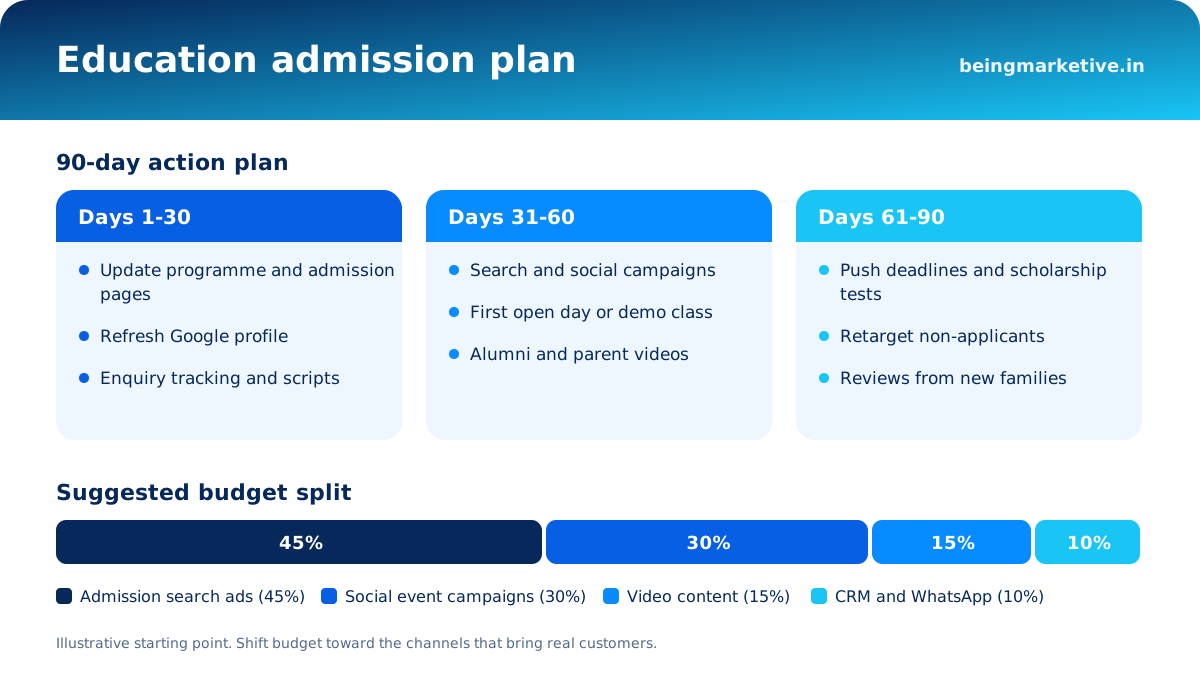
- Days 1 to 30: update programme and admission pages, refresh Google profile and photos, set up enquiry tracking and prepare counsellor scripts.
- Days 31 to 60: launch search and social campaigns, run the first open day or demo class, publish alumni and parent videos and start WhatsApp nurturing.
- Days 61 to 90: push application deadlines and scholarship tests, retarget visitors who did not apply, and collect reviews from newly admitted families.
Budget guidance
Many schools and colleges spend 3 to 8 percent of fee revenue on marketing. A practical digital split is about 45 percent on admission-season search ads, 30 percent on social campaigns for events, 15 percent on video content and 10 percent on tools such as CRM and WhatsApp messaging. Shift budget to whatever produces campus visits and applications.
Related playbooks and services
Read our social media marketing guide for student-facing content, our SEO strategy guide for course and location searches, and the IT Product playbook if you sell online courses or an edtech product.