Home / Industries / E-commerce

E-commerce marketing strategies

A playbook for online stores that want steady organic traffic, profitable paid campaigns and customers who come back.

E-commerce marketing overview

Online shoppers compare quickly and leave easily. Success depends on clear product pages, trusted delivery and return policies, fast checkout and a reason to return. Marketing must bring qualified visitors while the store removes friction.

Challenges include rising ad costs, marketplace competition, cart abandonment and thin margins. Because margin matters, measure profit per order, not just revenue.

E-commerce marketing overview

The complete e-commerce marketing playbook for Indian D2C brands and online stores

Selling online in India is no longer about getting traffic. It is about profitable traffic. Ad costs rise every festive season, return-to-origin rates on cash on delivery orders eat into margins, and marketplaces compete with your own website for the same buyer. The brands that grow are the ones that know their numbers: customer acquisition cost, average order value, repeat purchase rate and contribution margin after returns and shipping.

Online store owner packing a customer order in a cardboard box

Who this playbook is for

D2C brands on Shopify or WooCommerce, sellers on Amazon, Flipkart, Meesho and Myntra who want their own website, and local stores starting to sell online. Fashion, beauty, home, food and electronics brands all use the same core system, with different creative and seasonality.

Step 1: Fix the store before scaling ads

  • Product pages that sell: six or more real photos, a short video, size or usage guide, delivery time by pincode, clear return policy and honest reviews with photos.
  • Speed and checkout: most Indian shoppers buy on mobile. Keep pages fast, offer UPI, cards, wallets and cash on delivery, and reduce checkout to as few steps as possible.
  • Trust signals: GST details, customer support number, WhatsApp support, secure payment badges and a visible returns process.
  • Tracking: set up GA4, Meta pixel with conversions API and Google Ads conversion tracking before you spend, so every rupee can be measured.

Step 2: SEO for categories and products

Category pages such as cotton kurtas for women or stainless steel water bottles capture shoppers ready to compare. Write a short helpful introduction, add filters, internal links and FAQs to each category page. Product pages should have unique descriptions, not text copied from the manufacturer. Buying guides and comparison articles bring earlier-stage traffic you can retarget later.

Step 3: Paid acquisition that stays profitable

Use Meta for discovery with strong creative: user-generated videos, unboxing, before-and-after and founder stories. Use Google Shopping and Performance Max for people already searching for your products. Set a target cost per acquisition based on your margin, not on what feels acceptable, and cut ads that do not reach it after a fair test.

Step 4: Retention is where profit lives

Acquiring a customer once and never seeing them again is the most expensive way to grow. Build an email and WhatsApp flow for welcome offers, abandoned carts, order updates, review requests and replenishment reminders. A loyalty programme or simple second-order discount can significantly improve repeat purchase rates in categories like beauty, food and personal care.

Step 5: Reduce RTO and returns

Confirm cash on delivery orders on WhatsApp before dispatch, offer a small discount for prepaid payment, and flag pincodes and customers with high return history. Lower RTO often improves profit more than any new campaign.
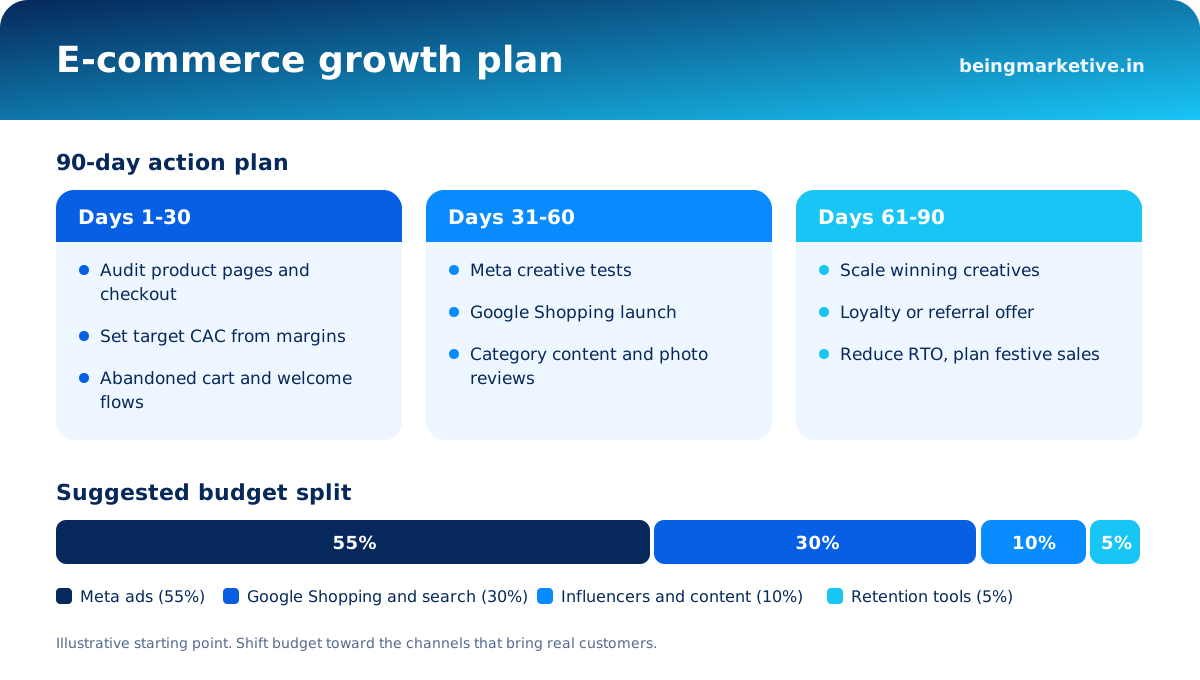
E-commerce 90-day growth plan and suggested ad budget split for D2C brands

A realistic 90-day growth plan

  • Days 1 to 30: audit product pages, speed, checkout and tracking; set target CAC from margins; set up abandoned cart and welcome flows.
  • Days 31 to 60: launch Meta creative tests and Google Shopping, publish category content and buying guides, start collecting photo reviews.
  • Days 61 to 90: scale winning creatives, launch a referral or loyalty offer, optimise RTO and prepare festive season campaigns early.

Budget guidance

Early-stage D2C brands often spend 15 to 30 percent of revenue on marketing while they grow. A common split is 50 to 60 percent on Meta, 25 to 35 percent on Google Shopping and search, and the rest on influencer seeding, content and retention tools. Track blended CAC against first-order and repeat margin every week.

Related playbooks and services

Go deeper with our paid advertising guide, the conversion optimization guide for product and checkout pages, and the retail playbook if you also run physical stores.

Target audience and customer journey

Shoppers enter at different stages. Create content for each.

Researchers

Compare features, reviews and prices before choosing a store.

Ready buyers

Search for a specific product and want fast, safe checkout.

Repeat customers

Respond to reminders, bundles and loyalty benefits.

Industry-specific SEO opportunities

Organic search can lower acquisition costs over time.

Category pages

Strong descriptions, filters and internal links to products.

Buying guides

Help shoppers choose between options and link to the right products.

Product schema and reviews

Mark up product data where eligible and display real reviews.

Content and social media strategy

Show products in use through short videos, photo carousels and customer questions answered. User-generated content works best with permission and clear credit.

Plan content around gifting seasons and festivals, and build email and WhatsApp updates for restocks and new arrivals.

Paid advertising opportunities

Paid campaigns should connect to margin and product feed quality.

Shopping and catalogue ads

Show products with price and image to people already searching.

Remarketing

Remind visitors about viewed products and abandoned carts.

Prospecting campaigns

Use video and carousel creative to reach new audiences.

Email and WhatsApp flows

Welcome, abandoned cart and post-purchase messages.

Lead generation and conversion strategy

Capture contact details with a sensible incentive, such as early access or a first-order benefit if margins allow. Make sure delivery times, return rules and payment options are visible before checkout.

Improve product pages with clear photos, size or usage information and honest reviews. See the conversion optimization guide for checkout ideas.

Lead generation and conversion strategy

Suggested marketing funnel

A funnel focused on repeat purchase.

01

Discover

Search, social and ads introduce products.

02

Evaluate

Product pages, reviews and comparison content build confidence.

03

Purchase

Simple checkout and clear policies.

04

Delight

Order updates and useful usage tips.

05

Return

Replenishment reminders and tailored offers.

Practical campaign examples (illustrative)

These are hypothetical teaching examples. They are not real client campaigns and do not show real results.

Illustrative: how-to reel

A home goods store shows one product solving one problem in thirty seconds.

Illustrative: buying guide

A fashion store publishes a fit guide and links to each size category.

Illustrative: abandoned cart flow

A beauty store sends a reminder with a product benefit and delivery information.

KPIs and measurement guidance

Look past revenue to profit and retention.

Conversion rate

Orders divided by sessions, by traffic source.

Average order value

Revenue per order, tracked over time.

Return on ad spend

Revenue from ads divided by ad cost, compared with margin.

Common marketing mistakes

Do this instead

Avoid these mistakes

E-commerce marketing FAQs

Most Indian brands do both. Marketplaces bring volume and trust, while your own website gives better margins, customer data and repeat purchases. Use marketplaces for discovery and push repeat buyers to your website with loyalty offers.

Confirm COD orders on WhatsApp or by call before dispatch, offer a prepaid discount, show accurate delivery dates and clear product details, and block repeat refusals. These steps commonly cut RTO noticeably.

There is no single number. Calculate the break-even ROAS from your gross margin after shipping, returns and payment fees. If your margin is 40 percent, you need at least 2.5x ROAS just to break even on the first order.

Start six to eight weeks before major sales such as Diwali. Build stock, test creatives early, grow your retargeting and WhatsApp lists, and finalise offers before ad costs rise.

Show total costs early, offer guest checkout, support trusted payment methods and send helpful reminders to people who agreed to them.

Often yes, especially for category and guide pages that answer specific questions. It takes longer than ads but compounds.

Marketplaces bring reach but limit customer data and margins. Many brands use both and send repeat buyers to their own store.

It depends on your margin, so calculate break-even first and compare results against that figure.

Related articles, services and resources

SEO strategy

Category and product SEO.

Conversion optimization

Product and checkout fixes.

Retail playbook

Compare with store-based retail.

Explore more marketing playbooks

See how other industries approach the same strategies, then pick one improvement to apply this week.