Eye care is one of the few healthcare categories where almost everyone becomes a customer eventually. Children need their first eye test, office workers stare at screens all day, people over 40 reach for reading glasses, and many older adults will need cataract surgery. Yet many eye hospitals and optical stores still wait for walk-ins.
The patients are already searching. They type “eye hospital near me”, “LASIK cost in Hyderabad” or “spectacles shop near me”, compare a few options and book the one that looks trustworthy and clear about price. This playbook shows eye hospitals and optical stores in India how to be that choice in 2026, and how to do it within the rules.
This article is marketing guidance, not legal advice. Check the current rules with your State Medical Council, NCAHP or your state drugs control department before you act.
Why eye hospitals and optical stores need a marketing playbook in 2026
- Two very different buyers. A cataract patient’s family wants safety, a trusted surgeon and insurance clarity. A college student wants trendy frames at a fair price. One message can’t serve both.
- Price comparison is easy. LASIK, cataract lenses and branded frames are compared online in minutes. Vague pricing sends people elsewhere.
- Online eyewear brands are everywhere. Large chains and online stores advertise heavily, so a local store has to give people a reason to visit.
- Eye care is recurring, but most businesses treat it as one-off. Glasses need updating, contact lens users need reviews, and diabetic patients need regular retina checks. Without reminders, those patients drift away.
- New advertising rules for doctors. In October 2026 the National Medical Commission (NMC) issued binding guidelines on ethical advertising for doctors and hospitals.
Two businesses, two rulebooks
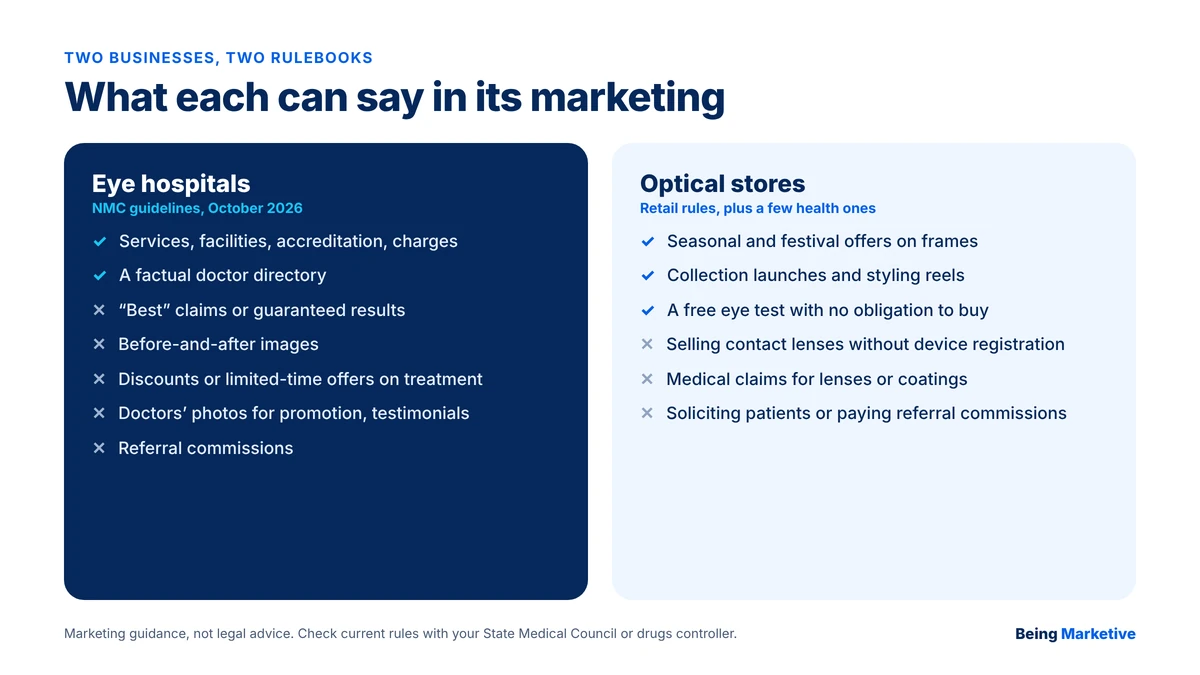
Eye hospitals and optical stores often sit side by side, but the rules that govern their marketing are different.
Eye hospitals and ophthalmologists: the NMC’s 2026 guidelines
On 6 October 2026 the NMC’s Ethics and Medical Registration Board issued its Guidelines on Ethical Advertising and Public Communication, effective immediately. They apply to registered medical practitioners, and hospitals are covered too. Violations by doctors can lead to penalties from State Medical Councils; violations by hospitals fall under state clinical establishment laws.
| Area | What the guidelines say | What it means for an eye hospital |
|---|---|---|
| Factual information | Hospitals may share name, contact details, departments, facilities, accreditation and charges | Publish services, equipment, timings and fee ranges clearly |
| Superlatives and guarantees | Claims like “best doctors” or “100% success” are prohibited; outcomes can’t be guaranteed | No “best LASIK centre” or “guaranteed spectacle freedom” |
| Before and after | Doctors can’t display before-and-after photos or advertise surgical results, except for scientific or educational use | Drop before-and-after visuals from ads and social posts |
| Offers | Discounts, limited-period offers, contests or free procedures that encourage unnecessary treatment are barred | No “LASIK at 30% off this week” campaigns |
| Doctors’ images and endorsements | Doctors’ photos can’t be used for self-promotion; no testimonials, influencer or celebrity endorsements | Promote services, not individual surgeons; skip patient testimonial videos |
| Doctor directory | A website directory with qualifications, specialities, registration and availability counts as patient information | Keep a factual “Our doctors” page |
| Commissions | No giving or receiving referral fees or commissions | Don’t pay optical stores, agents or platforms per patient |
| Reviews and rankings | Fake followers, reviews or manipulated rankings are banned; platforms can’t sell paid rankings of doctors | Grow reviews honestly; don’t buy top spots on listing apps |
| AI content | AI-generated promotional content must say it is AI-generated | Label AI-made images and videos |
Optical stores: retail rules, plus a few health-specific ones
An optical store is a retail business, so it has more freedom: it can run seasonal offers, festival sales and frame launches, as long as they are honest under consumer protection law. Three points need care:
- Contact lenses are medical devices. Since 2022, retailers selling medical devices, including contact lenses, have needed a registration certificate under India’s medical device rules. Confirm yours with your state drugs controller.
- Optometrists are healthcare professionals. Optometry comes under the National Commission for Allied and Healthcare Professions. Its draft conduct code bars soliciting patients and paying referral commissions, so keep your eye-test marketing professional.
- Don’t make medical claims. Say what a lens does (“anti-glare coating”, “blue-light filter”), not that it treats or prevents eye disease.
Know your customer: how people choose eye care
| Segment | What they need | What they search or ask | Message that works |
|---|---|---|---|
| Parents of school children | A child-friendly eye test and durable glasses | “eye test for kids near me” | Gentle tests, sturdy frames, follow-up reminders |
| Screen-heavy professionals | Relief from eye strain, quick service | “computer glasses”, “eye strain doctor” | Evening slots, same-day glasses, lens options explained |
| LASIK seekers (usually 18–40) | Eligibility, safety, cost | “LASIK cost in [city]”, “am I eligible for LASIK” | Eligibility test, procedure types, price ranges, surgeon qualifications |
| Older adults and their families | Cataract surgery, trust, insurance | “cataract surgery cost”, “eye hospital near me” | Cashless insurance, lens choices explained, family counselling |
| People with diabetes | Regular retina checks | “diabetic retinopathy test” | Screening schedule, reminders, coordination with their physician |
| Fashion-conscious eyewear buyers | Style, brands, value | “spectacle shop near me”, “[brand] frames price” | New collections, try-on, warranty, quick fitting |
Most people follow a similar path:
- Trigger. Blurry vision, headaches, a school screening note, a broken pair of glasses, or a doctor’s advice.
- Search. “Eye hospital near me”, “LASIK cost in [city]”, “optical shop near me”, or a question to family on WhatsApp.
- Compare. Ratings, reviews, prices, brands, distance and timings.
- Enquire. A call or WhatsApp to ask about cost, insurance, appointment slots or frame availability.
- Visit. Waiting time, the eye test, and how clearly options and prices are explained.
- Decide. Surgery, glasses or contact lenses. High-value decisions such as LASIK or cataract lenses can take weeks.
- Return. Annual check-ups, new frames and family referrals, if someone reminds them.
Most eye care businesses market only at step 2. The biggest gains usually come from steps 4 and 7.
The marketing channels that work best
- Google Business Profile — the starting point for “near me” searches, for both hospitals and stores.
- Service and cost pages on your website, especially for LASIK, cataract and contact lenses.
- Google Search ads for high-intent searches like “LASIK cost in [city]”.
- WhatsApp for enquiries, appointment reminders and annual recalls.
- Google reviews — the main trust signal when people compare.
- Instagram reels — eye-health education for hospitals, new collections and styling for stores.
- Community screening with schools, offices and housing societies, done the right way.
The eye care marketing playbook: 6 steps
Step 1: Fix your Google profiles and foundations
- Choose accurate primary categories: “Eye care center” or “Ophthalmologist” for the hospital, “Optician” for the store.
- If your hospital and optical store have separate counters, phone numbers and hours, Google allows them separate profiles. Otherwise, use one profile and list both as services.
- List every service separately: eye test, cataract surgery, LASIK, glaucoma care, retina clinic, paediatric eye care, contact lens fitting, frame repair.
- Upload real photos of the clinic, equipment and store displays. Hospitals should avoid promotional photos of individual doctors.
- Publish fee ranges and insurance or cashless options on your website.
Step 2: Run community eye-screening camps the right way
Screening camps at schools, offices and housing societies catch problems early and introduce people to your team. They also carry the most compliance risk, so plan them carefully.
- Make the camp about screening, not selling. The NMC allows doctors to take part in public health awareness if it doesn’t solicit patients. Don’t sell frames at the camp or offer camp-only treatment discounts.
- Get permission. Get written approval from the school, office or society, and parental consent for every child.
- Give a written result. Hand everyone a short report that says whether they need a full eye exam, and list your prices for one.
- Capture leads with consent. Use a simple booking form, on paper or a QR code, that asks permission to contact the person on WhatsApp. Don’t add numbers to promotional lists without consent; India’s Digital Personal Data Protection Rules, 2025 are being phased in.
- Optical stores can offer a free eye test at the store as a standing service. Keep it genuine, with no obligation to buy.
Step 3: Win high-intent searches like “LASIK cost in [city]”
People searching for LASIK cost or cataract surgery cost are close to deciding. Give them a dedicated landing page for each procedure, and send your search ads there.
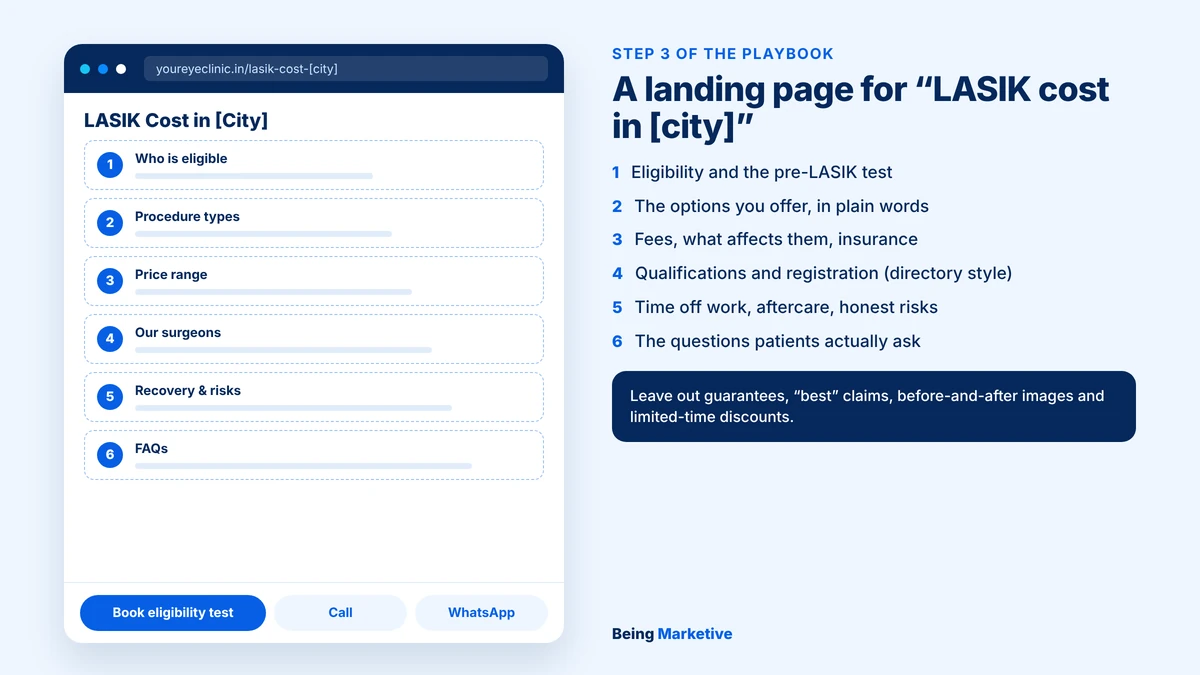
- Explain who is eligible and what the eligibility test involves.
- Explain the procedure types you offer, in plain language.
- Give price ranges and what affects them, including insurance where it applies.
- List your surgeons’ qualifications and registration details, in the factual directory style the NMC allows.
- Answer the questions people ask: recovery time, risks, time off work.
- End with a clear booking form, click-to-call and WhatsApp.
Leave out guarantees, “best” claims, before-and-after visuals and limited-time discounts. These are now barred for doctors and hospitals.
Step 4: Send WhatsApp reminders for check-ups and spectacle upgrades
Eye care is recurring. A simple reminder system brings back patients you have already won.
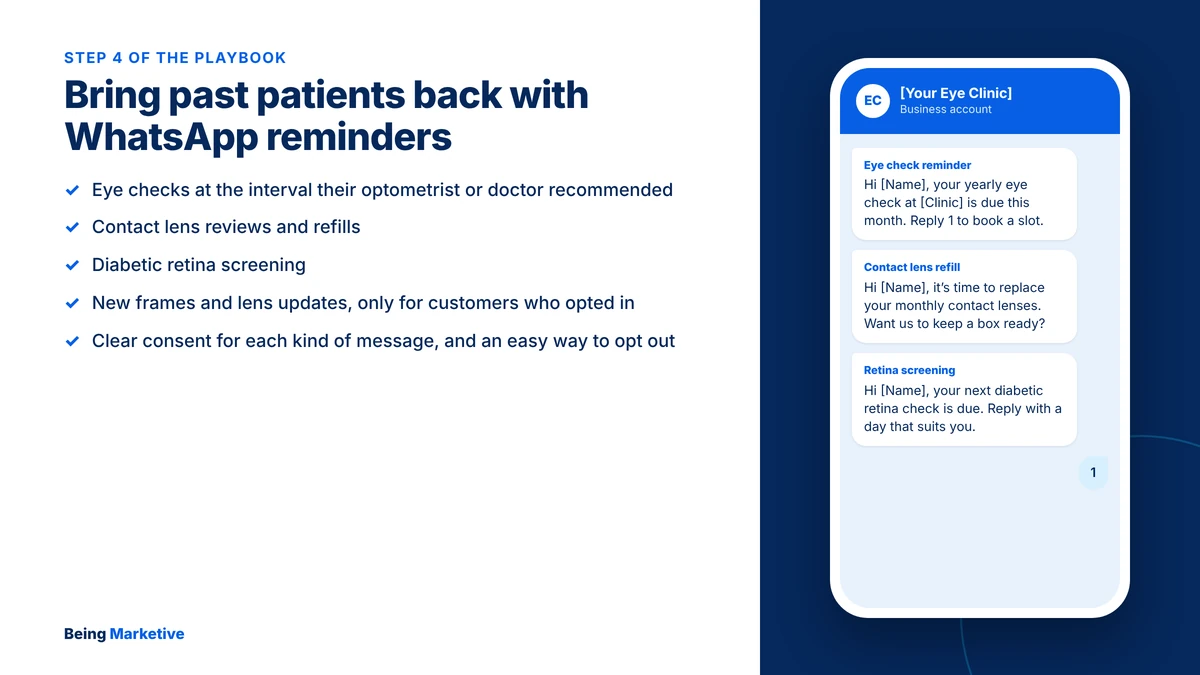
- Remind patients when their next eye check is due, at the interval their optometrist or ophthalmologist recommended.
- Remind contact lens users about reviews and replacement schedules.
- Send diabetic patients their retina screening reminders.
- Optical stores can let customers know when new collections arrive or when their glasses are due for an update, if the customer opted in.
- Collect clear consent for each kind of message, and make it easy to opt out.
Step 5: Give people a reason to visit the store
- Post short reels of new frame collections, face-shape guides and lens options.
- Promote in-store services online brands can’t match: a proper eye test, fitting, adjustments and same-day repairs.
- Run honest seasonal offers on frames, such as festival or back-to-school offers. Keep medical services out of these offers.
- Offer WhatsApp try-on: send a few frame photos for a customer to shortlist before they visit.
Step 6: Earn reviews the right way
- Ask every patient and customer for a Google review using a QR code at the counter or a link on WhatsApp.
- Don’t offer discounts or free items in exchange, and don’t ask only happy customers. Both break Google’s review policy, and the NMC bans fake reviews for doctors.
- Reply to every review. Hospitals shouldn’t mention a patient’s condition or treatment in replies.
Myth busted: “Local optical stores can’t compete with online brands”
Online eyewear brands spend heavily on advertising, so it’s easy to assume the local store has lost. But much of what people need from eyewear happens in person.
A local store can test eyes properly, fit frames to a face, adjust nose pads, fix a broken arm on the spot and deliver urgent glasses the same day. It can also remember a family’s prescriptions. Those are reasons to visit, and good marketing simply makes them visible.
The stores that compete well borrow the online playbook too. They show prices clearly, take WhatsApp bookings, post their collections online and collect reviews. They don’t need the biggest ad budget. They need to be the clear local choice when someone searches “optical shop near me”.
SEO for eye hospitals and optical stores
| Page | Example target query |
|---|---|
| Home page (hospital) | eye hospital in [area] |
| LASIK page | LASIK cost in [city], LASIK eligibility |
| Cataract page | cataract surgery cost in [city] |
| Children’s eye care page | eye test for kids in [city] |
| Optical store page | optical shop in [area], spectacles shop near me |
| Contact lens page | contact lens fitting in [area] |
- Cost pages win searches. People search for prices constantly. Clear price ranges answer them.
- Write for patients. Explain conditions and procedures in plain language, reviewed by a qualified professional.
- Use local signals. Put your area in page titles, embed a map, and keep directory listings consistent.
- Cover the basics. Use a fast mobile site with click-to-call. Add structured data: MedicalClinic for the hospital, Optician for the store.
The same local approach works across healthcare. See our playbooks for diagnostic labs,physiotherapy clinics and dental clinics, or explore healthcare and retail marketing.
Social media for eye care
- Hospitals: eye-health education, such as the 20-20-20 rule for screen users, signs a child needs an eye test, and when to get a diabetic eye check. Keep it evidence-based and avoid promoting individual doctors.
- Optical stores: new collections, face-shape guides, lens explainers and behind-the-scenes clips of fitting and repairs.
- Both: label any AI-generated images or videos, and never post a patient’s photo or details without written consent.
Paid advertising
Google Search ads are the most direct channel. Bid on procedure and cost searches, send each ad to its matching landing page, run call ads during working hours, and judge results by cost per booked consultation or eye test. Check Google’s Healthcare and medicines policy before launch.
Meta ads suit optical stores promoting collections and offers to people nearby. Hospitals can promote educational content. Avoid copy that implies the viewer has an eye condition, which Meta’s policies reject.
Conversion optimisation
- Phone number, WhatsApp and booking button visible on mobile without scrolling.
- Prices, insurance options and timings stated plainly.
- A factual doctor directory with qualifications and registration details.
- Real photos of the clinic, equipment and store.
- Quick replies on WhatsApp for prices, slots and frame availability.
Track monthly: enquiries by source, eye tests and consultations booked, procedures, glasses sold, recall messages that led to a visit, and new reviews.
Example: how a neighbourhood eye clinic and store could apply this
This is an illustrative scenario, not a real business or result.
An eye clinic with an attached optical store in a Hyderabad suburb gets most patients from walk-ins. Its Google profile lists only “eye clinic”, and no one reminds past patients about check-ups.
It adds every service to Google and builds cost pages for cataract surgery and LASIK. It runs Search ads on those two topics only. The store posts weekly reels of new frames and offers WhatsApp try-on. The team runs one screening camp a month at a local school with the school’s approval and parental consent. Everyone screened gets a written report, and follow-up happens only with their permission.
After three months, the clinic compares enquiries by source, consultations booked and recall visits against its starting point. That data decides where to spend next.
30-day action plan and budget tiers
| Week | Actions | Done when |
|---|---|---|
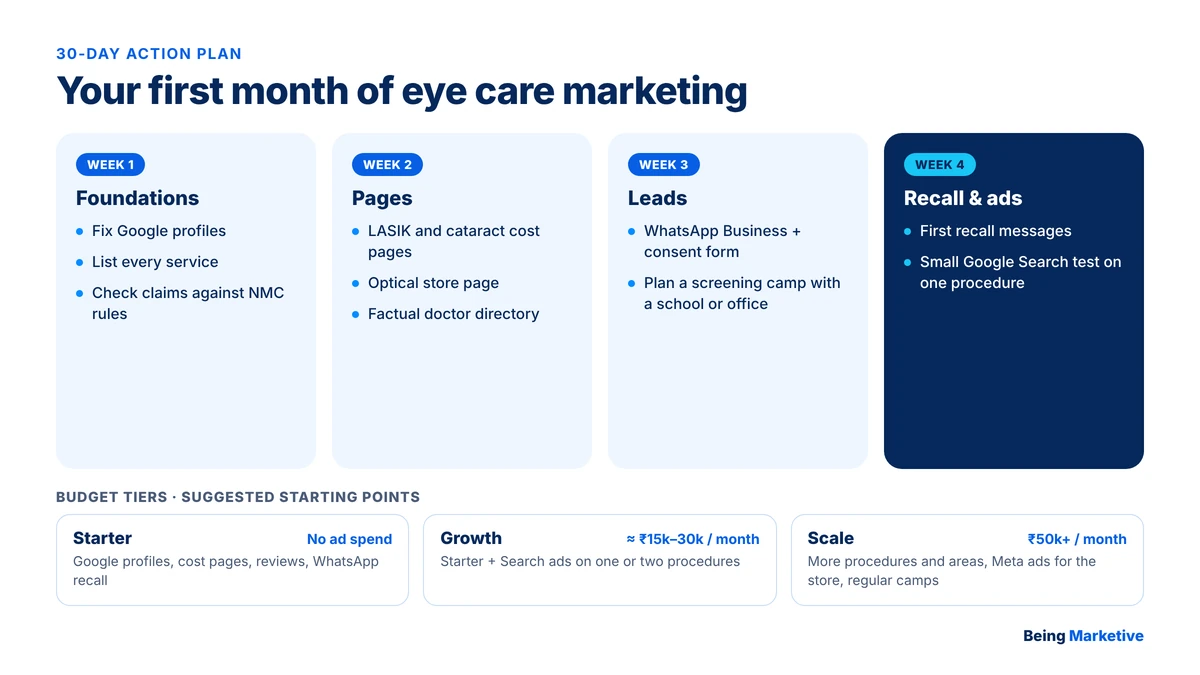
| Week 1: Foundations | Fix Google profiles and categories; list every service; check ads, social posts and website against the NMC guidelines | Profiles complete; non-compliant claims removed |
| Week 2: Pages | Build LASIK, cataract and optical store pages with prices; set up a factual doctor directory | Pages live |
| Week 3: Leads | Set up WhatsApp Business and a consent-based booking form; plan your first screening camp with a school or office | Camp approved; form working |
| Week 4: Recall and ads | Send the first recall messages to consenting past patients; launch a small Google Search test on one procedure | Reminders sent; ads running with call tracking |
These budget tiers are suggested starting points, not benchmarks. Adjust them to your city and capacity.
| Tier | Monthly ad spend | Focus |
|---|---|---|
| Starter | None | Google profiles, service and cost pages, reviews, WhatsApp recall |
| Growth | About ₹15,000–₹30,000 | Starter plus Google Search ads on one or two procedures, or store-collection ads on Meta |
| Scale | ₹50,000 and up | More procedures and areas in Search, Meta ads for the store, regular screening camps |
Common eye care marketing mistakes
- Advertising “best LASIK in the city” or guaranteed results.
- Running limited-time discounts on surgery.
- Using before-and-after images or patient testimonial videos for a hospital.
- Turning screening camps into sales events.
- Hiding prices until the patient walks in.
- Selling contact lenses without the right registration.
- Never reminding past patients about their next check-up.
- Buying reviews or offering rewards for them.
Conclusion
Winning patients in eye care comes down to being easy to find, clear about price and options, and present when people need you again. Eye hospitals now have to do that within the NMC’s 2026 advertising guidelines. Optical stores have more freedom, but they win the same way: clear information, real service and steady reminders.
Start with the 30-day plan and measure bookings, not likes. Being Marketive publishes industry playbooks like this regularly. Learn more about us, or get in touch for help applying it to your clinic or store.
Frequently asked questions
Can eye hospitals advertise in India?
Yes, within limits. The NMC’s October 2026 guidelines let hospitals share factual information such as services, facilities, accreditation and charges. They prohibit superlatives, guaranteed outcomes, before-and-after images, inducement offers and promoting individual doctors.
Can I run discounts on LASIK or cataract surgery?
Not as a promotion. The NMC guidelines bar discounts, limited-period offers and free procedures that encourage unnecessary treatment. Publish your regular fees clearly instead.
Are free eye-check camps allowed?
Doctors may take part in public health awareness that doesn’t solicit patients. Keep camps focused on screening, get permission and consent, don’t sell at the camp, and follow up only with people who agree.
Do optical stores need a licence to sell contact lenses?
Contact lenses are medical devices in India, and retailers selling medical devices have needed a registration certificate since 2022. Check the current requirement with your state drugs controller.
How can a local optical store compete with online eyewear brands?
Lean on what happens in person: eye tests, fitting, adjustments, quick repairs and same-day glasses. Add the online basics too: clear prices, WhatsApp booking, collection reels and reviews.
Sources
- Medical Dialogues: NMC issues ethical advertising and public communication guidelines (October 2026)
- Medical Dialogues: NMC bars promotional use of doctors’ photographs and paid rankings
- BioSpectrum: CDSCO sale registration requirement and contact lens retailers (2022)
- Careers360: NCAHP draft ethics code for allied healthcare professionals
- Google Maps: prohibited and restricted content
- Google Ads: Healthcare and medicines policy update